
SEO Services in Botswana Built to Increase Search Visibility and Generate More Enquiries
Improve how your business appears when potential customers search on Google with SEO built around search intent, stronger website pages, technical foundations, useful content and measurable organic performance.
Target commercially relevant searches
Strengthen pages Google and customers can understand
Improve technical and content foundations
Track visibility, traffic and enquiries over time
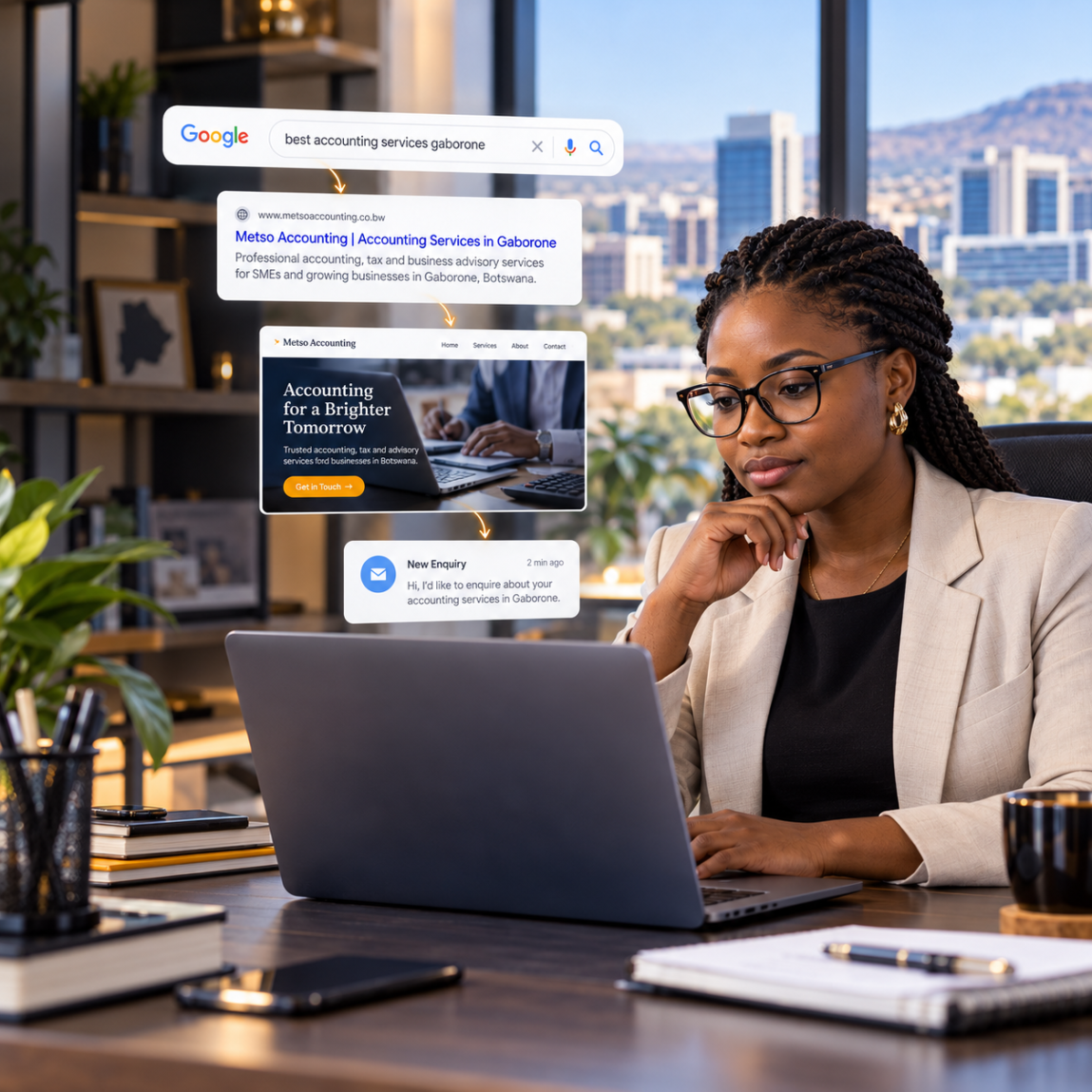
Having a Website Does Not Mean the Right Customers Can Find It
Your website can look professional and still struggle to appear when potential customers search for what your business offers. SEO problems often happen because Google cannot clearly understand the website, important pages do not match what customers are searching for, or competitors are providing stronger signals of relevance and usefulness.
Your Pages Target the Wrong Searches
Your website may describe what you do without using the language and search intent your potential customers actually use on Google.
Important Services Don't Have Strong Pages
Trying to rank one general page for several different services can make it difficult for search engines—and customers—to understand which page answers a specific search.
Google Has Trouble Crawling or Indexing the Site
Technical problems, poor architecture or indexing issues can prevent important pages from being discovered or properly understood.
Your Content Does Not Fully Answer the Search
A page may mention the right keyword but still fail to satisfy the question, problem or buying decision behind the search.
Your Website Has Weak Internal Structure
Important pages can become isolated when services, supporting articles and related topics are not connected through a clear internal linking structure.
Competitors Send Stronger Relevance & Authority Signals
Other businesses may have stronger service pages, better topical coverage, more useful references or stronger external signals supporting their websites.
You're Getting Visibility but Not Enough Clicks
Ranking is only part of the opportunity. Weak titles, descriptions or poor alignment with search intent can cause potential customers to choose another result.
Traffic Arrives but Few Visitors Become Enquiries
SEO should not stop at generating visits. The page still needs a clear offer, trust signals and an obvious next step.
The problem is not always “we need more SEO.”
The real constraint could be keyword targeting, service-page quality, technical SEO, content depth, site architecture, authority or the experience visitors have after they arrive.
SEO Connects What Customers Search For With What Your Business Offers
SEO works best when it aligns real customer searches with useful pages on your website, gives visitors enough confidence to take the next step, and measures what happens after they arrive.
Understand What Customers Are Searching For
Identify the searches potential customers use, which ones show meaningful commercial intent, and where your business has an opportunity to become more visible.
Build the Right Page for the Search
Match each important search need with a focused page that clearly explains the relevant service, product or solution.
Strengthen Relevance & Confidence
Improve content, structure, technical foundations and supporting signals so search engines and potential customers can better understand the page.
Turn Organic Visits Into Business Actions
Make it easy for visitors to call, request a quote, send a WhatsApp message, book or take the next step that matters to the business.
Measure What Search Is Producing
Track visibility, clicks, landing-page performance and customer actions so SEO decisions are based on real performance.
Improve What the Data Reveals
Use search queries, page performance, competitor changes and conversion data to decide what should be strengthened next.
SEO is not simply about ranking a page.
It is about building a system that helps the right customer find you, understand what you offer, trust the business and take the next step.
SEO Works Best When Customers Are Already Searching for What You Sell
SEO can be a strong long-term growth channel when your customers use Google to research, compare and choose businesses like yours. The best fit depends on search demand, customer value, competition, website readiness and how quickly you need results.
Customers Already Search for Your Services
There is real demand around the products, services or problems your business solves.
Organic Visibility Matters Long Term
You want to reduce dependence on paid traffic by building a stronger search presence over time.
Your Customer Value Supports Ongoing SEO Investment
A new customer is worth enough to justify investing consistently in visibility, content and optimization.
You Have Multiple Valuable Services or Products
SEO becomes more useful when different parts of the business can target different search needs and customer intentions.
Competitors Are Already Capturing Search Traffic
If competitors consistently appear for commercially relevant searches, SEO can help close the visibility gap.
Your Website Can Support the Opportunity
You either already have—or are willing to improve—the pages, content, technical foundations and conversion experience needed to turn visibility into business actions.
Sometimes another channel should come first.
SEO may deserve a lower priority when you need results immediately, there is very little search demand, the offer is still unclear, margins are extremely low, or the website is not ready to convert traffic.
SEO Services That Strengthen the Whole Organic Search System
Effective SEO usually requires several parts of the website to work together. We identify the areas creating the biggest opportunity, prioritize what matters most, and improve the parts that can strengthen relevant search visibility over time.
SEO Audit & Opportunity Analysis
Review current visibility, technical issues, content gaps, competitors and existing rankings to identify where SEO effort should be focused first.
Keyword & Search Intent Research
Find the searches potential customers use and separate useful commercial opportunities from keywords that may bring traffic but little business value.
On-Page SEO
Improve titles, headings, page copy, internal links, metadata and page structure so important pages are clearer to search engines and customers.
Technical SEO
Address crawlability, indexing, site structure, mobile usability, performance and technical issues that can limit organic search visibility.
SEO Content Strategy
Plan and improve service pages, articles and supporting content around distinct customer questions, search intent and topical gaps.
Internal Linking & Site Architecture
Connect related services, supporting content and commercial pages so users and search engines can understand how the website fits together.
Authority & Off-Page SEO
Review and strengthen external signals through relevant mentions, useful backlinks, outreach and authority-building opportunities where appropriate.
Ecommerce SEO
Improve product, category and store architecture for businesses that need customers to discover products through organic search.
SEO Performance Tracking & Reporting
Monitor search visibility, queries, landing pages, organic traffic and meaningful customer actions to guide ongoing decisions.
One SEO strategy. Multiple moving parts.
The goal is not to perform every SEO task at once. The goal is to identify what is currently limiting the website and improve the areas most likely to create meaningful progress.
Find What Is Limiting Your Search Visibility Before Deciding What to Fix
An SEO audit helps uncover the technical, content, keyword and structural issues that may be holding your website back. We combine that diagnosis with search-demand and competitor analysis so the next steps are based on evidence rather than guesswork.
Current Search Visibility
Review which pages and queries already generate impressions, clicks and rankings—and where useful visibility is being missed.
Technical SEO Health
Check crawlability, indexing, mobile usability, site structure, performance and technical issues that can interfere with organic search.
Keyword & Search Intent Alignment
Compare what your pages currently target with the language, questions and commercial intent customers actually use.
Content & Page Gaps
Identify missing service pages, weak supporting content, overlapping topics and pages that do not fully satisfy search intent.
Internal Linking & Site Architecture
Review how well important pages are connected and whether the site clearly communicates relationships between services and topics.
Competitor Search Visibility
See which competitors appear for valuable searches, what kinds of pages are winning visibility, and where there may be opportunities to differentiate.
Authority & Backlink Signals
Review relevant external mentions, backlink quality and whether competitors have stronger authority signals supporting their visibility.
Conversion Readiness
Check whether the pages attracting organic visitors make the offer clear, build trust and give visitors an obvious next step.
The result should be a priority list— not a report nobody uses.
The purpose of an audit is to determine what is limiting the website, where the strongest opportunities are, what should be fixed first and what can wait.
Target the Searches That Can Actually Matter to Your Business
Keyword research should do more than produce a list of phrases. We look at what potential customers search, what they are trying to accomplish, how competitive the opportunity is, and which page should own each search intent.
Start With Customer Language
Research the actual words, questions and comparisons people use when looking for services, products or solutions like yours.
Separate Traffic From Commercial Opportunity
A high-volume keyword is not automatically valuable. We look for searches that fit your offer, audience and customer journey.
Understand Search Intent
Someone researching a topic is in a different stage from someone actively searching for a provider. Those searches should not be treated the same.
Map Keywords to the Right Pages
Give important pages a clear search purpose so service pages, blogs and category pages support each other instead of competing.
Find Gaps Competitors Are Already Winning
Compare the searches competitors appear for, where your site is missing, and where stronger pages or content may create opportunity.
Prioritize by Business Value
We weigh relevance, commercial intent, competition, existing visibility and customer value—not search volume alone.
Different searches represent different stages of the buying journey.
The customer is learning
Useful for education, topical authority and early-stage discovery.
The customer is comparing
Useful for evaluation content, comparisons, pricing and decision support.
The customer may be ready to hire
Strong fit for service pages, pricing and provider-selection content.
The customer wants a nearby provider
Useful for geographic service pages and local-search visibility.
The right keyword is not always the one with the most searches.
The better question is which searches connect most naturally to what your business sells and the customer you actually want.
Turn Important Website Pages Into Stronger Search Results and Better Customer Experiences
On-page SEO improves how clearly each important page communicates its topic, purpose and value. We align the content, structure and search signals of the page with what customers are looking for—without sacrificing readability or conversion.
Page Titles & Search Snippets
Improve title tags and meta descriptions so search engines can understand the page and potential customers have a stronger reason to click.
Headings & Page Structure
Organize H1, H2 and supporting sections around a clear topic hierarchy that makes the page easier to scan and understand.
Service & Product Copy
Strengthen the page around the customer's search intent, questions, objections and decision-making needs instead of simply repeating keywords.
Keyword & Topic Alignment
Work primary, secondary and related search themes naturally into the page so relevance is clear without keyword stuffing.
Internal Links
Connect important service pages, supporting articles and related topics with descriptive links that help customers and search engines navigate the website.
Image & Media Optimization
Improve filenames, alt text, compression, dimensions and supporting media so images contribute to accessibility, page experience and topical context.
Structured Data & Page Signals
Use appropriate schema and supporting page information where useful to help search engines interpret the business, service or content more clearly.
Conversion Experience
Make sure SEO traffic reaches a page with a clear offer, credible information, relevant proof and an obvious next step.
Search relevance alone is not enough.
A useful landing page needs to satisfy the search and then help the visitor understand whether your business is the right choice.
Make Sure Search Engines Can Access, Understand and Use Your Website Properly
Technical SEO focuses on the systems behind the website that affect how easily search engines can discover, crawl, index and interpret important pages. We look for problems that may limit visibility, waste crawl attention or create a poor experience for visitors.
Crawlability
Make sure important pages can be reached by search engines and are not accidentally blocked by technical settings or poor site structure.
Indexing
Check whether the right pages are eligible to appear in search and whether low-value, duplicate or unnecessary URLs are creating confusion.
Site Architecture
Organize the website so important services, categories and supporting content sit within a clear, logical structure.
Mobile Usability
Review whether pages work well on smaller screens, where many customers may discover and use the website.
Page Speed & Core Web Vitals
Identify performance issues that can hurt usability and make important pages slower or more frustrating to use.
Canonicals & Duplicate Content
Reduce unnecessary duplication and make it clearer which version of a page should be treated as the main one.
Structured Data
Use appropriate schema where useful to help search engines better interpret the business, services, products or content on the page.
Technical Errors & Monitoring
Watch for broken links, crawl errors, redirect problems, indexing changes and other issues that can quietly damage search performance.
Technical SEO should support the strategy— not become the whole strategy.
A technically healthy website still needs the right search intent, useful pages, strong content and a clear reason for customers to choose the business.
Build the Content Your Customers Need Before They Are Ready to Contact You
SEO content should help your business appear across more of the customer journey—not just publish articles for the sake of activity. We use search demand, intent and content gaps to decide which pages should be created, improved or connected.
Service & Commercial Pages
Create or strengthen pages for the specific services, products and commercial searches most closely connected to revenue.
Informational Content
Answer the questions customers ask before they are ready to enquire, helping the business build visibility earlier in the buying journey.
Comparison & Decision Content
Support customers comparing options, costs, approaches or providers before making a decision.
Content Gap Analysis
Identify useful customer questions, topics and search opportunities competitors cover that your website currently does not.
Topic Clusters
Connect related articles and service pages so the website develops stronger topical depth around areas that matter to the business.
Existing Content Improvement
Update pages that already have impressions or rankings but may need stronger intent alignment, depth, structure, CTR or conversion.
Content Consolidation
Reduce unnecessary overlap by merging weak or competing pages when several pieces of content target essentially the same search intent.
SEO Briefs & Content Direction
Turn keyword and intent research into clear content briefs so each page has a defined purpose, audience, angle and internal-link role.
Different questions appear at different stages.
A strong SEO content strategy helps the business show up when customers are learning, comparing and deciding—not only when they are ready to buy.
Search strategy decides what should exist and why.
SEO Content Strategy determines which search opportunities should be addressed and how pages should support organic visibility. Content Marketing handles broader content creation, publishing and distribution across channels.
More content is not automatically better SEO.
The goal is to build useful, distinct pages with a clear purpose—not a larger website full of overlapping articles competing with each other.
Help Search Engines and Customers Understand How Your Website Fits Together
Internal linking and site architecture connect your important service pages, supporting content and related topics into a clear structure. This helps search engines understand page relationships while making it easier for visitors to move from research to the next relevant step.
Parent & Child Page Structure
Organize broad services and specialist services into a logical hierarchy so search engines can understand which pages are central and which pages support them.
Service-to-Service Connections
Link related services where the customer journey naturally overlaps, such as SEO, Local SEO, Content Marketing, Web Design and Google Ads.
Blog-to-Service Internal Links
Use informational content to support relevant commercial pages and give readers a logical path from learning to evaluating a service.
Descriptive Anchor Text
Use links that clearly explain where the visitor is going instead of vague phrases like “click here.”
Topic Clusters
Group related content around important commercial themes so articles strengthen a broader subject rather than existing as isolated posts.
Navigation & Click Depth
Make important pages easier to reach without forcing users or search engines through unnecessary layers.
Cannibalization Control
Reduce situations where several pages compete for the same search intent by giving each important page a distinct purpose.
Conversion Paths
Guide visitors toward the most relevant service, pricing, case study, resource or enquiry page based on what they are currently reading.
Every important page should have a clear role.
A strong architecture helps broad services, specialist pages, supporting content and commercial actions reinforce each other.
Your website should not feel like a collection of disconnected pages.
It should function as a structured system where important pages support each other and every visitor has a logical next step.
Strengthen the Signals That Support Your Website Beyond Your Own Pages
Off-page SEO focuses on the external signals that can help search engines understand whether a business is credible, relevant and connected to its market. We look for opportunities to strengthen authority through useful mentions, relevant links, citations and outreach—not shortcuts.
Backlink Profile Review
Assess the quality, relevance and distribution of links already pointing to your website and identify obvious weaknesses or risks.
Relevant Link Opportunities
Look for credible websites, directories, publications, associations and industry resources where a natural link or mention may make sense.
Local & Industry Citations
Strengthen consistent business references across relevant directories and industry sources where appropriate.
Digital PR & Outreach
Identify opportunities to earn mentions through useful stories, resources, expert insight, partnerships or genuinely newsworthy business activity.
Link-Worthy Content Assets
Create useful resources, guides, data, tools or insights that other websites may have a real reason to reference.
Brand Mentions
Monitor and strengthen references to the business across the web, especially where those mentions help reinforce topical or geographic relevance.
Competitor Link Analysis
Review where relevant competitors earn links and mentions to identify gaps, realistic opportunities and patterns worth understanding.
Ongoing Authority Monitoring
Track new links, lost links, suspicious patterns and changes in the site's external authority profile over time.
More backlinks are not automatically better backlinks.
The goal is to build stronger relevance and credibility through useful, natural external signals—not to chase link quantity for its own sake.
Need Customers to Find You in Google Maps and Local Search?
General SEO focuses on helping your website become more visible across relevant organic searches. Local SEO goes further for businesses that depend on customers in specific towns, cities or service areas by improving how the business appears across Google Search, Google Maps and Google Business Profile.
Broader Organic Search Visibility
Best for improving how your website appears across valuable service, product and informational searches.
- Service-page optimization
- Technical SEO
- Keyword strategy
- SEO content
- Site architecture
- Organic performance tracking
Google Maps & Local Search Visibility
Best for businesses that need customers to discover them in a specific town, city or service area.
- Google Business Profile
- Google Maps visibility
- Local search terms
- Local citations
- Reviews and trust signals
- Service-area relevance
Local SEO is especially useful when customers choose by location.
If location matters to the customer, Local SEO should usually be part of the search strategy.
Explore the dedicated Local SEO service for Google Business Profile, Maps visibility, local search optimization and other location-focused work.
Help More Customers Discover Your Products Through Organic Search
Ecommerce SEO improves how product pages, category pages and store architecture are understood by search engines and discovered by customers. The goal is to make important products easier to find across commercially relevant searches without relying only on paid advertising.
Product Keyword Research
Identify the searches customers use when looking for specific products, product types, brands and buying options.
Category Page Optimization
Strengthen category pages around broader product demand so customers can discover groups of relevant products through search.
Product Page SEO
Improve product titles, descriptions, headings, internal links, images and structured data to make individual products clearer and more competitive.
Ecommerce Site Architecture
Organize categories, subcategories, filters and product relationships so important pages are easier for users and search engines to navigate.
Technical Ecommerce SEO
Review crawlability, indexing, duplicate URLs, filters, faceted navigation, canonicalization and other technical issues common to stores.
Internal Linking for Products & Categories
Connect related products, categories, buying guides and commercial pages to strengthen discovery and help customers move through the store.
Structured Data for Products
Use appropriate product, offer and related schema where useful to help search engines interpret product information more clearly.
Ecommerce Content Strategy
Support product and category pages with useful buying guides, comparisons and informational content that can attract customers earlier in the buying journey.
Ecommerce SEO helps customers move from search to product discovery.
An online store should not depend on paid advertising alone.
Strong ecommerce SEO can help build a more durable source of product discovery by improving how important products and categories appear in search.
SEO for Small and Growing Businesses That Want More Valuable Search Visibility
Small-business SEO should focus on the searches most closely connected to real customer demand. We help Botswana businesses prioritize the pages, search opportunities and improvements that make sense for their size, market and growth goals.
Service Businesses
Target the services customers are actively searching for and strengthen the pages that can turn those searches into calls, forms or WhatsApp enquiries.
Professional Firms
Build visibility around high-value service searches while strengthening trust, expertise and decision-support content.
Schools & Education Providers
Improve visibility for parents, students and families researching schools, courses, enrolment options and education services.
B2B Companies
Capture research, solution and provider-selection searches used by businesses comparing suppliers, partners or specialist services.
Ecommerce Businesses
Improve discovery of products and categories through organic search while reducing dependence on paid traffic alone.
Growing SMEs With Multiple Services
Create a clearer SEO structure across service pages, supporting content and customer-intent clusters as the business expands.
Small-business SEO should be prioritized around business value.
The goal is not to do every SEO task at once. The goal is to identify the opportunities and problems most likely to affect relevant visibility, customer acquisition and growth.
Small-business SEO should not mean doing less important work.
It should mean prioritizing better, avoiding wasted effort and focusing on the searches most likely to matter to the business.
Know Whether Your Search Visibility Is Actually Improving
SEO performance should be measured across the full journey—from how often your business appears in search to what visitors do after they reach the website. We use search and website data to understand what is improving, where opportunities are emerging and what should be worked on next.
Search Visibility
Track impressions, ranking movement and the range of relevant searches your website appears for.
Organic Clicks & CTR
Monitor how often searchers choose your result and whether titles, descriptions and search-intent alignment are attracting enough clicks.
Landing Page Performance
See which pages are attracting organic visitors, where engagement is strongest and which pages may need improvement.
Keyword & Query Trends
Identify searches gaining visibility, declining queries, new opportunities and shifts in how customers are finding the website.
Technical Search Health
Monitor indexing, crawl issues and important technical changes that can affect whether pages remain eligible to appear in search.
Organic Traffic Quality
Look beyond visit counts to understand which pages, topics and searches are attracting relevant users.
Customer Actions
Where tracking is available, monitor forms, calls, WhatsApp clicks, purchases, bookings or other actions that matter to the business.
Opportunities & Priorities
Use the data to decide what should be improved next instead of repeating the same SEO tasks every month.
Rankings are one signal. Business-relevant performance is the bigger picture.
Clear SEO Pricing Based on the Level of Search Growth Your Business Needs
SEO requirements vary depending on your market, website, competition and growth goals. Our packages give you a clear starting point, with broader SEO support available for businesses that need more than local search visibility.
Local SEO Foundation
Best for businesses primarily focused on attracting customers from specific towns, cities or service areas.
Primarily focused on local search rather than broader organic SEO.
Explore Local SEOSEO Growth
Best for businesses that want broader organic visibility across commercially valuable services, topics and customer searches.
SEO Authority
Best for businesses competing across more valuable or competitive searches and needing a broader ongoing SEO program.
SEO needs time for research, implementation, crawling, indexing and enough performance data to guide the next decisions.
We do not promise specific positions or first-page rankings. The focus is improving relevant organic visibility and the business opportunity created from it.
Start with the business problem— not the package name.
Tell us what you sell, where your customers are and what you want search to help you achieve. We can recommend the most sensible starting point.
A Clear SEO Process From Diagnosis to Ongoing Improvement
SEO works best when the work follows a clear sequence. We start by understanding the business and current search performance, then prioritize the opportunities that matter most before implementing, measuring and improving.
Understand the Current Situation
Review the business, website, current visibility, competitors, customer journey and the main problems limiting search performance.
Find the Search Opportunities
Review search demand, keywords, search intent, existing rankings, content gaps and opportunities across the market.
Decide What Should Come First
Rank technical, content, page and authority improvements according to business value, urgency and likely impact.
Improve the Website
Strengthen service pages, content, internal links, technical foundations and other agreed SEO priorities.
Track What Changes
Monitor visibility, clicks, landing-page performance and meaningful customer actions so progress is based on real data.
Use the Data to Guide the Next Move
Refine priorities, strengthen underperforming areas and identify the next opportunities as search performance develops.
SEO is not a one-time checklist.
Search demand changes, competitors improve, new content is published and customer behaviour evolves. The process should keep learning from the data rather than repeating the same tasks every month.
You do not need to know what should be fixed first.
Tell us about the business, the website and what you want organic search to help you achieve. We can recommend the most sensible starting point.
SEO vs Local SEO vs Google Ads: Which Fits Your Business Goal?
The right approach depends on what customers search for, where you need to appear, how quickly you need visibility and whether you want to build organic presence, capture local demand or pay to reach high-intent searchers sooner.
SEO
Best for building broader organic visibility over time.
- Valuable service and product searches
- Broader organic visibility
- Service pages and SEO content
- Reduced dependence on paid traffic
- Long-term search asset
Local SEO
Best for attracting customers in specific towns, cities or service areas.
- Google Maps visibility
- Google Business Profile
- Local and “near me” searches
- Reviews and local trust signals
- Location and service-area relevance
Google Ads
Best for reaching high-intent searchers sooner through paid visibility.
- Faster access to search demand
- Keyword and location targeting
- Budget-controlled campaigns
- Lead-generation opportunities
- Useful while SEO is developing
| Comparison | SEO | Local SEO | Google Ads |
|---|---|---|---|
| Main goal | Broader organic visibility | Local & Maps visibility | Paid search visibility |
| Traffic type | Organic | Organic / local | Paid |
| Best when | Customers search for your services or products | Location influences the buying decision | You want high-intent visibility sooner |
| Geographic focus | Broad or targeted | Specific areas | Flexible targeting |
| Google Business Profile | Supporting | Major focus | Not primary |
| Content & service pages | Major focus | Supporting | Landing pages important |
| Pay per click | No | No | Yes |
| Long-term asset | Strong | Strong locally | Visibility depends on continued spend |
The right answer can be more than one channel.
Google Ads can capture valuable searches now, SEO can build broader organic visibility over time, and Local SEO can strengthen Maps and geographic discovery. The right combination depends on the business goal, market and timeline.
SEO Built Around Business Growth, Not Just Rankings
We approach SEO as part of the wider customer-acquisition system. That means understanding what your customers search for, strengthening the website they land on, measuring what happens after the click and prioritizing the work most likely to matter to the business.
Business-First SEO
We start with what the business sells, who the ideal customer is and which search opportunities are most commercially relevant before deciding what to optimize.
Search Intent Before Search Volume
A keyword does not become valuable simply because many people search for it. We prioritize relevance, buyer intent and business value alongside demand.
Website + SEO Thinking Together
SEO cannot compensate for a confusing or weak website. Because we also work in web design and development, technical, content and conversion issues can be considered together.
Botswana Market Context
The strategy is built around the market you actually serve, including local search behaviour, geographic demand and realistic competition rather than copying a generic overseas playbook.
Transparent Priorities
You should understand what is being worked on, why it matters and what the next priority is instead of receiving a list of unexplained SEO tasks.
No Guaranteed-Ranking Promises
We do not sell SEO using promises of guaranteed first-page or number-one positions. Search performance depends on many factors outside any agency's control.
Measurement Beyond Rankings
Visibility matters, but so do clicks, landing-page performance, enquiries and other meaningful actions that show whether search traffic is creating opportunity.
Connected Digital Marketing Support
Where SEO is not enough by itself, the wider strategy can connect with Local SEO, Google Ads, Content Marketing and Web Design rather than forcing one channel to solve every problem.
Diagnose. Educate. Prescribe.
We do not start by assuming every business needs the same SEO package. The recommendation should come from the problem, the opportunity and the business goal.
The goal is not to make SEO look complicated.
The goal is to make the next growth decision clearer, measurable and commercially sensible.
Learn How Search Visibility Actually Works Before You Invest
Explore practical SEO guides created for Botswana businesses. Learn how keyword research, Local SEO, authority, analytics and search strategy work—and use those insights to make better decisions about where to invest.
Start with the topic closest to the problem you are trying to solve.
SEO Marketing
Ready to grow your online presence? This practical guide to SEO marketing in Botswana covers everything from keyword research and local optimization to technical SEO…
Read Guide →
Keyword Research 101: How to Choose the Right Keywords
Want more website traffic? Our Keyword Research 101 guide shows Botswana business owners how to find and use the right SEO keywords to get found…
Read Guide →
Local SEO for Small Businesses: Rank Higher in Your Area
Struggling to get found by local customers? Discover how local SEO for small businesses can help you rank higher in Botswana searches, from Gaborone to…
Read Guide →
SEO vs. SEM: Understanding the Difference & When to Use Each
SEO or SEM? One brings long-term organic traffic, the other brings immediate paid leads. Learn how to choose the right search marketing strategy for your…
Read Guide →
Backlinks Explained: How to Build Quality Links Without Penalties
Ever wondered why some Botswana websites always appear on page one of Google? Learn what backlinks are, how they work, and safe ways to build…
Read Guide →
Measuring Success: How to Analyze Website Traffic Using Google Analytics
Stop guessing and start growing. Learn how to analyze website traffic using Google Analytics 4 (GA4) to understand your Botswana customers and improve your digital…
Read Guide →Want to go deeper?
Browse the complete SEO resource library for more guides on organic search, website visibility, analytics, Local SEO and search strategy for Botswana businesses.
Questions Businesses Ask Before Investing in SEO
Understand SEO pricing, timelines, services, measurement and the difference between SEO, Local SEO and Google Ads before deciding what makes sense for your business.
01 How much does SEO cost for a small business? +
SEO cost depends on the website, competition, target searches and amount of work required. At Lephutshi Developers , broader SEO Growth currently starts at P5,900/month, while businesses primarily focused on Google Maps and local search can start with Local SEO from P3,500/month.
Rather than choosing SEO purely by price, the better question is which search opportunities could realistically create value for the business. View SEO pricing and packages .
02 Is SEO worth paying for? +
SEO can be worth investing in when potential customers already use Google to research or find the services or products your business provides.
The strongest case exists when commercially relevant searches can produce enquiries, sales or other valuable customer actions over time. Lephutshi Developers starts by identifying search demand and business opportunity rather than assuming every company needs the same SEO package.
03 How long does SEO take to work? +
There is no universal SEO timeline. Results depend on the website's current condition, competition, existing authority, technical issues, content and the searches being targeted.
Some improvements may become visible relatively quickly, while competitive organic growth usually develops over a longer period. That is why Lephutshi Developers treats SEO as an ongoing cycle of research, improvement, measurement and refinement rather than promising rankings within a fixed number of days.
04 Is SEO worth it for a small business? +
It can be when customers are actively searching for what the business sells and the value of those customers justifies the investment.
Small businesses usually do not need every SEO tactic at once. They need the right priorities. Lephutshi Developers focuses small-business SEO on commercially relevant searches, important service pages, technical foundations, useful content and measurable customer actions.
05 What is included in SEO services? +
Professional SEO can involve much more than adding keywords to website pages.
Depending on the business, Lephutshi Developers SEO services can include SEO audits, keyword and search-intent research, on-page SEO, technical SEO, service-page optimization, SEO content strategy, internal linking, site architecture, authority work and performance reporting.
The exact priorities should depend on what is currently limiting the website.
06 Is it worth hiring an SEO agency? +
Hiring an SEO agency can make sense when organic search represents a meaningful business opportunity but the company does not have the strategy, time or specialist resources to manage SEO consistently.
A provider should be able to explain what is being worked on, why it matters and how progress will be evaluated. Lephutshi Developers uses a Diagnose → Educate → Prescribe approach so recommendations begin with the business problem rather than a predetermined tactic.
07 Which is better for my business: Google Ads or SEO? +
Neither is automatically better. SEO is generally suited to building organic search visibility over time, while Google Ads can put the business in front of targeted searchers sooner through paid placements.
In some cases the strongest strategy combines both: Lephutshi Developers Google Ads management can capture existing search demand while Lephutshi Developers SEO services build broader organic visibility.
08 Do I need SEO or Local SEO? +
Broader SEO is useful when you want the website to become more visible across valuable product, service and informational searches.
Local SEO becomes especially important when customers choose businesses based on location, proximity or service area. Lephutshi Developers Local SEO services focus more deeply on Google Business Profile, Google Maps, reviews, citations and local relevance.
09 What does an SEO audit include? +
An SEO audit should identify what is limiting the website and which opportunities deserve attention first.
A Lephutshi Developers SEO audit and recommendation can examine current search visibility, technical SEO health, crawlability, indexing, keyword alignment, important pages, content gaps, internal linking, competitors, authority signals and conversion readiness.
The useful outcome should be a prioritized action plan—not simply a long technical report.
10 How do I know if SEO is working? +
Do not judge SEO only by whether one keyword moved up or down.
Lephutshi Developers looks at the broader search journey: Visibility → Clicks → Landing-page performance → Customer actions → Improvement.
Depending on the tracking setup, useful signals may include impressions, organic clicks, CTR, query growth, organic traffic, engagement, forms, calls, WhatsApp clicks, purchases or bookings. The bigger question is whether improved search visibility is creating meaningful business opportunities.
Turn More Google Searches Into Opportunities for Your Business
Tell us what your business sells, who your customers are and what you want Google to help you achieve. We will review the opportunity and recommend the most sensible next step—whether that is SEO, Local SEO, Google Ads or a combination.
Start with the business goal.
You do not need to choose an SEO package before speaking to us. Tell Lephutshi Developers what you want the business to achieve and we can help identify the most sensible search-growth path.