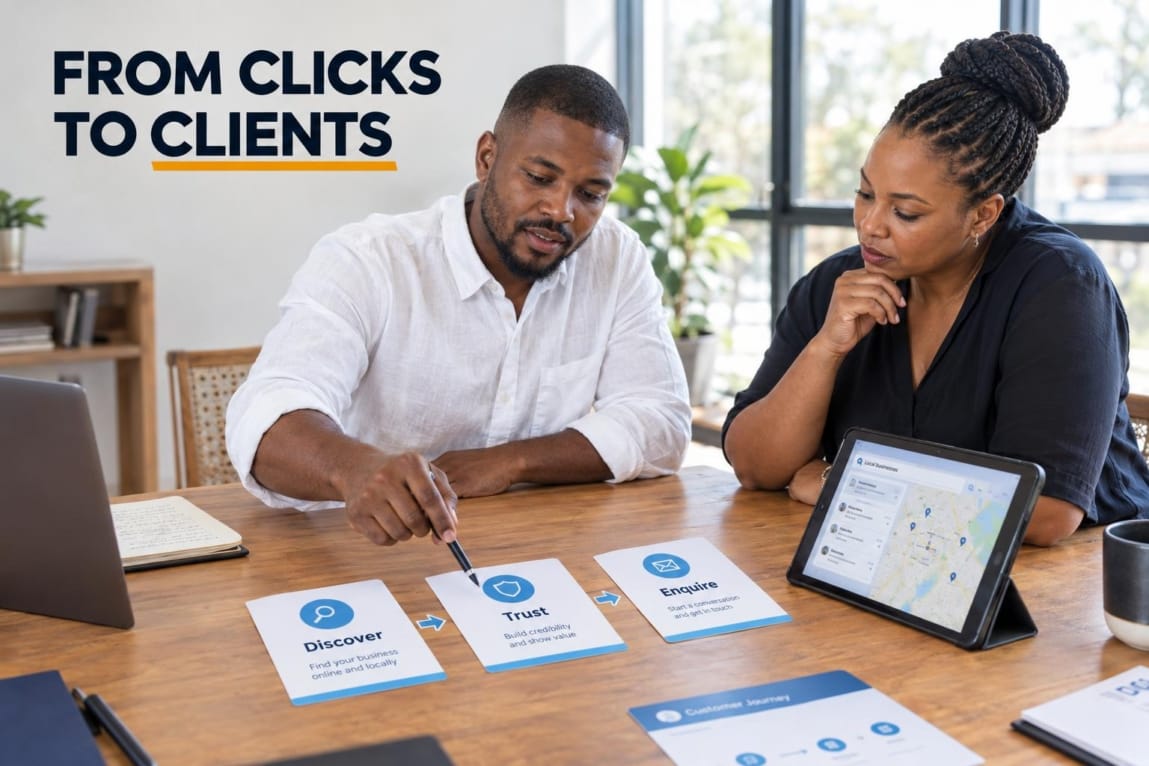

If you want to know how to get customers online in Botswana, do not start by posting more often or boosting every offer. Build a connected system that helps the right people find you, trust you, enquire easily, receive a fast response, and become customers.
For many Botswana SMEs, the problem is not a total lack of online activity. It is a broken path between a Facebook post, Google search, website visit, WhatsApp message, quotation, and sale. This guide shows how to fix that path using a practical five-stage customer acquisition framework.
Direct answer: the five-stage online customer acquisition system
Online customer acquisition is the process of turning digital attention into profitable customer relationships. A reliable system has five connected stages: Discover (people find your business), Trust (they believe you are credible), Enquire (they can contact you with little effort), Follow Up (your team moves the conversation forward), and Measure (you identify which activity produces worthwhile customers).
A weakness at any stage can waste the work done before it. Advertising cannot compensate for a confusing landing page, and a good website cannot recover enquiries that receive no reply.
Why “More Marketing” Does Not Equal More Customers
Reach, likes, clicks, and followers can indicate attention, but they are not customer acquisition. A campaign can reach thousands of people in Gaborone, Francistown, or Maun and still produce little revenue if the offer is unclear, the business looks unverified, or nobody owns incoming enquiries.
Think of your marketing as a pipe rather than a collection of separate activities. Prospects can leak out when they cannot find you on Google, cannot tell what you offer, do not see proof, struggle to contact you on a phone, wait too long for a response, or receive a quotation with no follow-up.
- Traffic leak: Your ideal buyer searches but cannot find a relevant Google result or local listing.
- Trust leak: A prospect arrives but sees vague claims, missing business details, or no evidence of real work.
- Conversion leak: The page has no obvious call, WhatsApp, or simple form option.
- Sales leak: An enquiry sits unanswered, is sent to the wrong person, or is never followed up.
- Measurement leak: You know how much you spent, but not which enquiries became paying customers.
The goal is not to use every customer acquisition channel. It is to choose channels that match buyer intent, then connect them to a credible, responsive sales process.
The 5-Stage Customer Acquisition Framework
This framework helps you diagnose where your next customer is being lost before you spend more money.
- Discover: Capture people already looking for your service and create awareness among suitable future buyers.
- Trust: Make it easy to verify who you are, what you do, where you operate, and why a buyer should choose you.
- Enquire: Give a mobile visitor a clear, low-friction way to call, message, book, or submit a useful form.
- Follow Up: Respond quickly, qualify the need, provide the next step, and continue appropriate follow-up.
- Measure: Link marketing spend and channel activity to qualified leads, sales, and customer value.
Use the framework as a self-assessment. If you had 20 interested prospects this month, could each one find you, verify you, contact you, get a timely answer, and be recorded as a real sales opportunity? If not, improve that weak stage before increasing the budget.
Stage 1 — Capture Existing Demand with Search and Local SEO

Search is especially valuable when someone already has a need. A person searching for a lawyer in Gaborone, an air-conditioning repair service, office IT support, accommodation in Maun, or a supplier may be closer to making a decision than someone casually scrolling a social feed. That does not make search universally better than social media; it means the intent and journey are different.
Start with the searches your customers use when they need help now. Combine the service, product, problem, and location: for example, “accountant Gaborone”, “catering Francistown”, or “website designer Botswana”. Build pages and offers that answer the need clearly instead of trying to rank one generic homepage for everything.
For businesses with a real location or defined service area, a Google Business Profile is an important local discovery asset. Keep the name, phone number, category, address or service area, hours, photos, and website consistent with reality. Follow Google’s Business Profile representation guidelines: a listing should accurately represent a real business, not a duplicate or keyword-stuffed version of one. Compliance supports a sound foundation; it does not guarantee Maps visibility or enquiries.
Ask satisfied customers for honest reviews, reply professionally, and publish useful local information. For a practical implementation guide, see how to optimize a Google Business Profile for local SEO.
When the search terms are commercially valuable and you need visibility while organic work develops, paid search can test and capture immediate demand. Track meaningful actions, not just ad clicks. Businesses that need campaign setup, landing-page alignment, and ongoing optimisation can explore Google Ads management for high-intent local searches.
Stage 2 — Create Demand Through Social Media and Targeted Ads

Social media is useful when a buyer may not be actively searching yet. Facebook and Instagram can introduce a specialised product, show a before-and-after service result, explain a problem, or keep a business visible while the customer considers options. The job is not simply to collect likes. It is to move suitable people toward a useful next action.
Start with one audience and one offer. A training provider could promote a specific upcoming course. A building supplier could show a product use case. A consultant could offer a short discovery call for a defined business problem. Match the creative, location targeting, landing page, and follow-up route to that offer.
Use hyper-local targeting carefully. A business serving only Gaborone should not pay for enquiries it cannot reasonably fulfil elsewhere. Equally, a Botswana-wide business should explain delivery, service coverage, or remote-consultation arrangements before a prospect has to ask.
Meta ads can also open a direct conversation: WhatsApp documents how WhatsApp chats can be started from Facebook and Instagram ads. This route works only when someone can answer promptly and guide the conversation toward a real next step. For a deeper channel decision, compare Google Ads and Facebook Ads for Botswana businesses; the better choice depends on intent, offer maturity, sales cycle, and conversion path.
If your team needs help connecting content, paid campaigns, local targeting, and reporting, consider social media marketing support for lead generation. First, make sure the enquiry journey is ready to receive the attention you create.
Stage 3 — Overcome the Local Skepticism Barrier by Building Immediate Trust
When a prospect discovers an unfamiliar business online, they often make a quick credibility judgement. In Botswana, where phone and WhatsApp conversations may play a large part in the buying journey, your digital presence should make it easy for a person to confirm that they are dealing with a real, capable business before they message or pay.
Put the facts a cautious buyer needs near the top of key pages:
- A clear description of the service, product, and intended customer.
- A working phone number, business email, and appropriate location or service-area information.
- Real business photos, product images, portfolios, credentials, team information, or relevant project evidence.
- Specific service scope, process, response expectations, and next steps.
- Testimonials or reviews presented accurately, without exaggerated claims.
- Consistent business details across your website, Google profile, and social accounts.
A professional website is not just a brochure. It is a place where a prospect checks whether your message, proof, contact details, and offer make sense together. Google’s people-first content guidance similarly emphasises helpful, reliable content and clear information that helps people assess who is behind it. These principles are useful for people first; they are not a ranking guarantee.
Show evidence rather than relying on generic claims such as “quality service”. For an example of how a local organisation’s digital presence can be presented, review a Botswana digital marketing case study for a pre-school. Treat any case study as context, not a promise that another business will achieve identical outcomes.
Stage 4 — Convert Attention into Direct Enquiries: WhatsApp, Calls, and Forms
A visitor should not have to search for a way to do business with you. Every service page, campaign landing page, and product page needs one primary action: call for urgent needs, WhatsApp for conversational enquiries, request a quote through a form, book a consultation, or buy online where the transaction is ready for it.
Design this stage for phones first. According to Botswana’s 2024 ICT survey, mobile phones via cellular networks were used by 87.2% of internet users, while 57.5% of individuals aged five and above used the internet. That is a strong reason to test pages on a real phone: buttons should be easy to tap, calls should work, forms should be short, and important information should appear before excessive scrolling.
WhatsApp can be a practical conversion option for businesses whose customers prefer a direct conversation, but do not assume it suits every buyer or every offer. Use a pre-filled message such as “Hello, I would like a quote for [service]” and route the chat to a named owner. Keep a phone option for urgent decisions and a form for enquiries that need structured details, documents, or a formal consultation request.
| Channel | Buyer intent | Conversion speed | Best conversion tool | Often suitable for |
|---|---|---|---|---|
| Google Search | Often immediate or problem-led | Can be fast when the offer matches the search | Call, quote form, location page, WhatsApp | Local services, urgent needs, B2B solutions |
| Meta Ads | Discovery or consideration-led | Depends on audience awareness and offer clarity | Landing page, lead form, WhatsApp chat | Retail, events, visual services, demand creation |
| Organic social | Usually lower immediate intent | Often slower and relationship-led | Profile link, direct message, content offer | Community building, proof, repeat visibility |
A useful path is simple: search or ad → focused page → proof and clear offer → call, WhatsApp, or form → owned follow-up. Remove distractions from campaign pages. If an ad promotes one service, the page should explain that service rather than sending people to a crowded homepage.
Stage 5 — Plug the Leaks: Rapid Follow-Up and Lead Retention
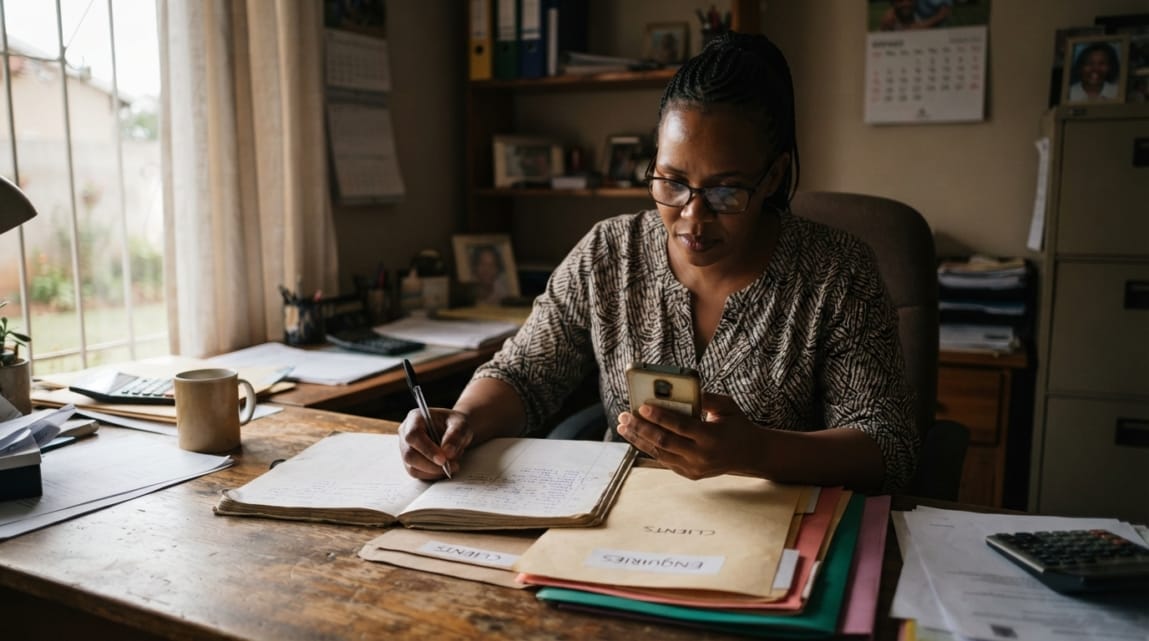
Generating an enquiry is not the finish line. Assign a person to own each channel, define working-hour response expectations, and make sure they can answer the first questions: price range where appropriate, availability, location, what is included, and the next step.
Set an internal target that your team can actually meet. Fifteen minutes may be a useful operational goal for a staffed WhatsApp inbox, but it is not a universal evidence-based rule. Directionally, research on the short life of online sales leads found that firms attempting contact within an hour were far more likely to qualify leads than those waiting longer. The research is older and based on US data, so use it as a reason to measure speed, not as a Botswana sales guarantee.
Create a simple lead-handling workflow:
- Acknowledge the enquiry and confirm who will assist.
- Ask the few questions needed to qualify the request.
- Provide a clear next action: a call, visit, quote, proposal, booking, or checkout link.
- Record the source, need, status, and next follow-up date.
- Follow up politely when a prospect has not decided, then record the outcome.
WhatsApp Business can help teams organise conversations with profiles, greeting or away messages, quick replies, labels, catalogues, and action buttons. Review the available WhatsApp Business features for customer conversations and select only what fits your process and account availability. Automation should support a timely human response, not hide one.
For longer B2B decisions, email is often the follow-up layer after the first conversation: send a capability document, proposal, useful case material, or meeting recap, then use a planned nurture sequence. Businesses with consultative sales cycles can explore email marketing and lead-nurturing support, while keeping clear human ownership of high-intent enquiries.
Measuring What Matters: Acquisition Cost and Lead Quality
Measurement turns acquisition marketing from guesswork into a managed business process. Define what counts as a conversion before launching a campaign: a qualified WhatsApp enquiry, a completed quote form, a phone call of a useful length, a booking, a purchase, or a signed client. Google Ads supports separate tracking for actions such as forms, calls, and purchases through its Google Ads conversion tracking options. A tracked action is not automatically revenue; connect it to your sales records where possible.
Review these figures monthly:
- Lead volume: How many enquiries arrived from each source?
- Qualified lead rate: How many matched your budget, location, need, and decision timeline?
- Lead-to-client conversion rate: What proportion of qualified leads became customers?
- Customer acquisition cost (CAC): Total marketing and sales cost for a period ÷ new customers acquired in that period.
- Return on ad spend (ROAS): Revenue attributed to ads ÷ ad spend, where revenue tracking is reliable.
- Customer value: Whether a customer is likely to buy again, renew, refer, or purchase additional services.
Do not choose a channel solely because it produces the cheapest leads. Ten low-quality messages can cost more time than two qualified enquiries from a more expensive source. Review lead quality with the person who actually speaks to prospects, not only the advertising dashboard.
Real-World Acquisition Systems: Three Botswana Blueprints
The local service blueprint
A legal practice, medical service, repair business, or specialist contractor may begin with a location-focused Google Business Profile, service pages for high-intent searches, and targeted paid search where appropriate. The page should show service area, credentials, process, and an obvious call or WhatsApp option. A staff member then responds, checks the need and location, and arranges the next step. This model is strongest when speed, availability, and trust are visible.
The B2B corporate blueprint
A logistics company, IT provider, or consultant may need a longer path. Search visibility and professional social positioning bring in potential decision-makers; a capability page or document establishes fit; a structured form gathers project details; and a consultation is followed by a proposal and planned email nurturing. Here, fewer well-qualified opportunities can matter more than high lead volume.
The retail and lifestyle blueprint
A seller of specialised equipment, high-value goods, or lifestyle products may use visual social advertising to demonstrate the product, then send prospects to a verified catalogue or focused product page. Clear stock, delivery or collection information, payment steps, and a WhatsApp route for questions reduce hesitation. Confirm operational details before scaling ads, because an attractive campaign cannot fix unavailable stock or unclear fulfilment.
The 30-Day Customer Acquisition Action Plan
You do not need to rebuild every digital asset at once. Use the first month to establish a working baseline and improve the biggest leaks.
- Week 1: Audit and track. List every current lead source, test your own website on a phone, call the listed number, submit the form, message the WhatsApp line, and document where the journey fails. Set up a simple lead register with source, status, value, and outcome.
- Week 2: Fix trust and conversion paths. Correct contact details, business information, service descriptions, proof, primary calls to action, and mobile usability. Confirm that every enquiry route has an owner.
- Week 3: Launch one focused demand test. Choose either high-intent search or a targeted social campaign based on your offer. Use one audience, one location strategy, one clear offer, and one conversion route.
- Week 4: Review and improve. Measure response time, qualified enquiries, appointments, sales opportunities, and closed customers. Improve the message, landing page, audience, or follow-up process based on what the sales team records.
Keep the first test narrow enough to learn from it. Expanding several channels before you know which offer and enquiry path work can make the results harder to interpret.
Conclusion: Building an Asset, Not Just Running an Ad
Getting more customers online in Botswana is less about finding a single best platform and more about building a dependable path from discovery to sale. Start by fixing the largest leak: become easier to find, make your business credible, simplify the enquiry route, respond quickly, and measure which sources create customers rather than empty activity.
If you want an outside view of that system, Lephutshi Developers can help you request a customer-acquisition audit focused on discoverability, trust assets, enquiry paths, follow-up, and measurement.
Recommended Reading
- How to Optimize Google Business Profile for Local SEO
- Google Ads vs. Facebook Ads: Which Is Best for Botswana Businesses?
- Digital Marketing for Pre-Schools in Botswana: Case Study
FAQ
- What is the fastest way to get clients online in Botswana?
For an offer with existing demand, targeted Google Ads or local search visibility paired with a clear call or WhatsApp route can generate enquiries quickly. Results still depend on the offer, landing page, targeting, budget, and how fast your team responds. - How do I attract more clients if my marketing budget is small?
Start by improving your Google Business Profile, service pages, contact details, customer reviews, and enquiry response process. These assets can make existing search, referrals, and social activity more likely to produce useful enquiries before you increase paid advertising. - Why am I getting website visitors or ad clicks but no customer enquiries?
The likely issue is a leak between attention and action: weak trust signals, unclear offers, slow mobile pages, difficult forms, missing calls to action, or no convenient call or WhatsApp option. Test the journey yourself on a phone and ask a few customers where they hesitated. - What is the best platform to find customers online in Botswana?
There is no single best platform for every business. Google Search can capture people with an immediate need, while Facebook and Instagram can create awareness and demand. Choose based on your customer, offer, sales cycle, location, and ability to handle enquiries. - How can I attract and keep customers online?
Attract customers with useful visibility and credible offers, then keep them through reliable service, prompt communication, accurate information, and relevant follow-up. Track repeat purchases, renewals, referrals, and customer questions so your marketing and service process improve together.