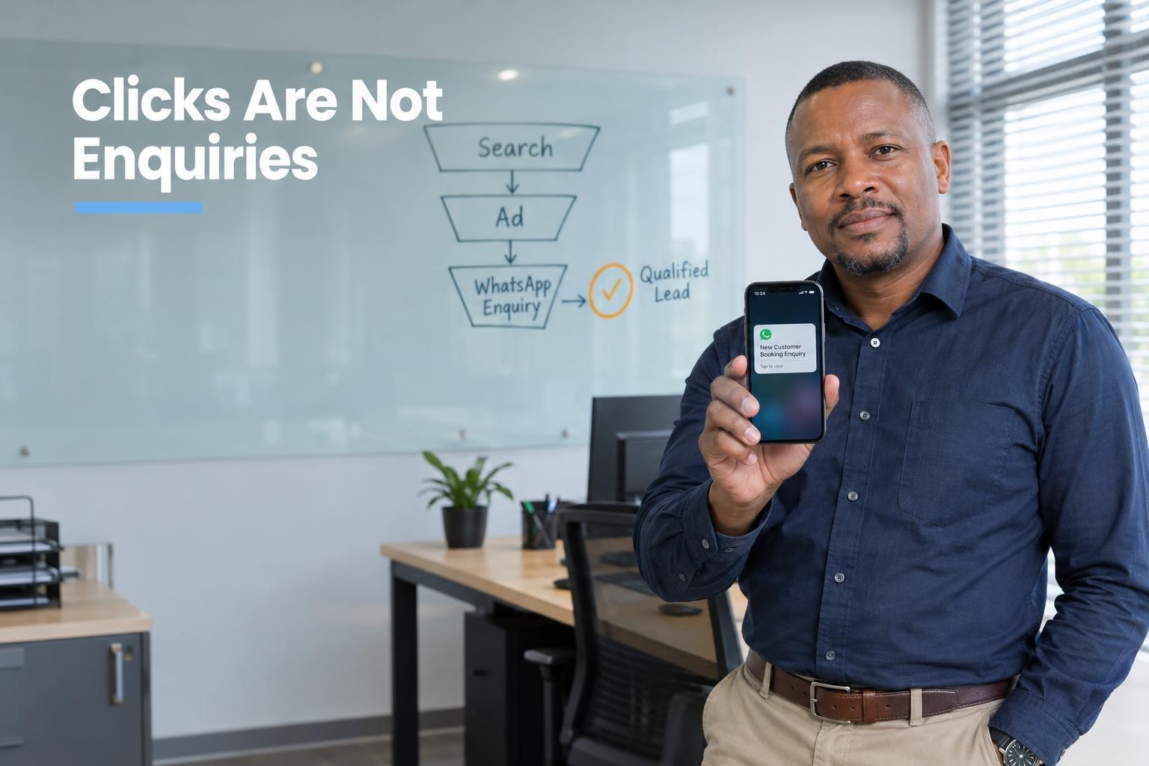

Learning how to get leads from Google Ads in Botswana is not mainly about buying more clicks. It is about building a clear path from a person searching for a service to a real enquiry, a qualified opportunity and, ultimately, a customer. If your ads receive visits but your phone, inbox or WhatsApp stays quiet, one part of that path is broken.
A practical Google Ads lead-generation system has six stages: Search → Ad → Landing Page → Conversion Action → Qualification → Sale. Target people who show buying intent, send them to a page that fulfils the ad’s promise, make it easy to enquire, track what happened, and follow up promptly. In Botswana’s relatively focused search market, relevance usually matters more than chasing raw traffic volume.
How a Google Ads Lead-Generation System Works

A lead-generation campaign is designed to create measurable business conversations: quote requests, booking requests, phone calls, WhatsApp messages or useful form submissions. An awareness campaign may aim for reach, views or visits. Both can have a role, but they should not be judged by the same outcome.
Search Ads are especially useful for service businesses because they can appear when someone is actively looking for a solution. A person searching for “commercial cleaning company in Gaborone” is in a different position from someone passively seeing a cleaning advert while scrolling through social media. Search captures existing demand; social advertising often creates or interrupts attention.
The system works only when every stage supports the next:
- Search: A potential customer uses a phrase that reveals a need.
- Ad: Your advert confirms that you offer the relevant service, in the relevant area or for the relevant problem.
- Landing page: The page gives enough information and trust to continue.
- Conversion action: The visitor calls, submits a form, starts a WhatsApp chat or books an appointment.
- Qualification: Your team checks fit, urgency, location, budget or scope.
- Sale: A suitable lead receives a timely quote, consultation or proposal and may become a customer.
For a deeper explanation of auctions, bidding, networks and relevance, see how Google Ads works for Botswana businesses. The important point here is that an ad account is not the whole acquisition system; it is the entry point to one.
Search Intent vs. Traffic Volume: Why Clicks Fail to Become Leads
More traffic does not automatically mean more enquiries. A campaign can generate many inexpensive clicks from people researching, comparing careers, looking for free information or seeking something you do not provide. Those clicks still spend your budget.
For lead generation, separate search intent into three broad groups:
- Informational: “How does HVAC maintenance work?” or “forklift training notes.” These searches may be useful for content marketing but are often early-stage for a paid service campaign.
- Commercial investigation: “Best commercial cleaning company Gaborone” or “corporate training providers Botswana.” The person is evaluating options.
- Transactional or immediate-service intent: “Hire forklift Francistown,” “emergency plumber near me,” or “request security services quotation.” These searches can indicate a more immediate need.
Botswana businesses may work with modest search volumes for specialised services. That makes precision important: a small number of highly relevant searches can be more valuable than a large number of vague visits. Start with the services, towns, buyer types and problems that your sales team can actually serve well.
Choosing Keywords That Signal Genuine Buying Intent
Build keyword groups around the language a ready buyer is likely to use. Useful modifiers can include service type, location, urgency and commercial action: “commercial cleaning company in Gaborone,” “equipment rental Botswana,” “legal consultation Gaborone,” “corporate training quote,” or “air conditioning repair office.” Do not assume every modifier fits every business; use the language found in your customer enquiries and sales conversations.
Also decide which searches are unsuitable. If you do not offer jobs, free resources, salaries, DIY advice, courses or retail products, those words may be candidates for exclusion. Google explains how negative keywords work: they can prevent ads from appearing for irrelevant searches, but they must be applied carefully because negative matching behaves differently from positive keyword matching. Review real search terms before adding broad exclusions so you do not block a valuable query.
A keyword list is not a once-off task. Expand it from actual enquiries, search-term findings and the wording buyers use when requesting quotes. For a fuller process, explore PPC keyword research for Botswana businesses.
Ad-Message to Landing Page Alignment: Keeping the Commercial Promise

Your advert creates an expectation. If the ad says “Commercial Cleaning Quotes in Gaborone,” the first thing a visitor should see is confirmation that you provide commercial cleaning in Gaborone and a clear route to request a quote. Sending that visitor to a broad homepage, where they must hunt through several services, creates unnecessary friction.
This is called message match. Ads, keywords, landing pages and calls to action should closely align; Google’s guidance on matching ads and landing pages also connects this alignment with ad relevance and landing-page experience. Alignment does not guarantee a conversion, but it reduces the chance that visitors leave because the page does not deliver what the advert promised.
A focused service landing page should usually include:
- A headline that names the service, customer type or location from the advert.
- A short explanation of the problem you solve and what the enquiry process covers.
- Relevant proof points, such as service scope, operating areas, business contact details or genuine testimonials where available.
- A mobile-friendly layout with a visible call, WhatsApp or form option.
- A clear next action, such as “Request a site assessment” or “Get a quotation.”
- Enough detail to help a serious buyer decide to contact you, without forcing them through unnecessary pages.
Test the page on an actual mobile phone and a typical mobile connection. Check that buttons are easy to tap, the contact number works, forms are not frustratingly long and essential information appears before a visitor has to scroll too far. If your current site cannot support this journey, consider a website designed to generate enquiries rather than relying on a generic homepage for every paid campaign.
Calls, Forms, or WhatsApp: Structuring Conversions for the Botswana Market

There is no universal best enquiry channel. Some prospects may prefer a quick call for an urgent service; others may want to send photos, locations or initial details through WhatsApp; B2B buyers may prefer a structured request for quotation form. Treat channel choice as a testable business decision based on your own customers, service complexity and ability to respond.
| Conversion channel | Best for | Advantages in Botswana | Disadvantages or risks | Qualification level |
|---|---|---|---|---|
| Phone call | Urgent, high-value or complex enquiries | Fast clarification and direct human contact | Missed calls, limited written detail and inconsistent call handling | Can be high if staff use a short qualification script |
| WhatsApp click-to-chat | Mobile-first enquiries, sharing photos, locations or quick questions | Convenient conversation channel and easy follow-up history | A click does not prove a message was sent; informal chats can be poorly recorded | Varies; use prompts to collect service, location and timing |
| Website form | Quotes, B2B services and enquiries requiring defined details | Captures structured information for email or CRM follow-up | Long forms can create drop-off, particularly on mobile | Usually stronger when fields are relevant and limited |
| Google-hosted lead form | Capturing contact details without a website visit | Short path from ad to submitted details | Requires account eligibility, policy compliance and a reliable lead-delivery process | Varies; volume should not be confused with sales readiness |
A WhatsApp or call button can be measured as a website action when the site is tagged correctly. Google provides instructions to track contact-button clicks as conversions. Record this as an intent signal, not as proof that a WhatsApp conversation happened, the person was qualified or a sale closed.
For calls, distinguish a tap-to-call click from deeper call reporting. Google’s phone-call conversion tracking options have different setup requirements, and some methods rely on Google forwarding numbers that depend on country and account eligibility. Confirm what is available in your live account before designing reporting around it.
Google Ads lead form assets are another optional route. Before relying on them, confirm eligibility, policy requirements, how leads will be delivered and who will contact them. For many service businesses, a simple landing page with a well-managed call, WhatsApp and form option gives better control over the enquiry experience.
Tracking Lead Quality, Not Just Click Volume
A conversion action is a valuable customer action that you choose to measure. Google Ads can measure different actions, including website activity and phone calls, through Google Ads conversion actions. The key business decision is deciding what each action is worth.
For example, these are not equal outcomes:
- A visitor clicks a WhatsApp button.
- A visitor sends a message.
- Your team confirms the person needs your service, is in your service area and has a realistic requirement.
- The prospect accepts a quote and becomes a customer.
Start simple. Keep a shared spreadsheet, CRM or lead register with the date, source, keyword or campaign where known, enquiry type, status and final outcome. Every week, compare Google Ads leads with the leads your sales team judged to be suitable. This exposes situations where a campaign appears successful because it creates many button clicks but few genuine opportunities.
As your process matures, offline feedback can be reflected in Google Ads through qualified and converted lead goals. This relies on your own CRM or internal lead process. It is useful, but a small business does not need an advanced integration before it starts recording which enquiries became worthwhile conversations and customers.
Cost Per Lead and Customer Economics for Botswana SMEs
Google Ads does not charge one fixed price per lead in Botswana. Costs vary with the service, competition, keyword intent, location targeting, ad relevance, landing page performance and your sales process. Rather than using an unsupported market benchmark, calculate what a lead can be worth to your business.
Use these basic relationships:
- Cost per lead (CPL) = advertising spend ÷ recorded leads.
- Cost per acquisition (CPA) = advertising spend ÷ new customers.
- Clicks per lead = clicks ÷ leads. Therefore, CPL can also be understood as cost per click multiplied by clicks needed to produce one lead.
- Lead-to-sale rate = new customers ÷ qualified leads.
Consider an illustrative B2B example, not a market benchmark. A company spends BWP 6,000 on ads, receives 12 recorded enquiries and gains two new contracts. Its CPL is BWP 500 and its advertising CPA is BWP 3,000. Whether that is profitable depends on the gross profit from each contract, the likelihood of repeat work, delivery costs and the company’s capacity to serve the customer.
Customer lifetime value (LTV) matters where a customer may renew a maintenance agreement, place repeat orders or use several services. A campaign that looks expensive when measured against the first invoice may make sense when measured against profitable long-term customer value. Conversely, no spreadsheet can rescue leads that the business cannot fulfil or follow up.
What Happens After the Click: Immediate Lead Follow-Up Protocols
Paid search can create the opportunity, but the business must handle it. A missed call, an unanswered WhatsApp message or a form that sits in an inbox until tomorrow can waste the value of a well-targeted click. Set a realistic response standard, assign ownership and make sure someone is available during the hours your ads run.
A practical protocol can be simple:
- Send an acknowledgement or answer the call as promptly as your team can.
- Capture the source, service needed, location, contact name and preferred reply channel.
- Ask only the qualification questions needed to decide the next step: “What service do you need?”, “Where is the site?”, “When do you need it?” and “What scope should we quote for?”
- Explain the next action clearly, such as a site visit, callback, proposal or appointment.
- Log the outcome and follow up on open quotations at a defined time.
For WhatsApp, a saved opening response can help: “Thank you for contacting us. To prepare the right quotation, please share the service required, your location and a convenient time for a call.” Keep the tone human, and avoid asking for sensitive information before it is necessary.
Diagnostic Checklist: What to Fix When Google Ads Leads Dry Up
Do not immediately increase the budget when enquiries weaken. Work through the route from search to sale and identify where the evidence changes.
- Inspect actual search queries. Use the Google Ads Search Terms Report to see the kinds of searches that triggered ads. It helps identify relevance problems, but interpret it alongside conversion and lead-quality data; not every individual query may be visible in reporting.
- Check negative keywords. Remove clearly irrelevant demand without blocking useful variations of a commercial search.
- Verify conversion tracking. Submit a test form, click the call and WhatsApp buttons, and check whether the intended action is recorded correctly. A broken tag can make a working campaign look weak, while an overly broad conversion can make a weak campaign look healthy.
- Review the mobile landing page. Check loading behaviour, readability, forms, contact buttons and whether the first screen confirms the advert’s promise.
- Test every contact route. Call the published number, submit the form and open the WhatsApp link from a phone. Confirm notifications reach the right person.
- Check visibility constraints. Review whether budget, bids, targeting or impression share is limiting exposure for valuable searches before assuming demand has disappeared.
- Match ad copy to intent. An advert for a general service may need separate versions for emergency work, commercial clients, a particular town or a quote-led search.
- Audit lead handling. Compare recorded ad enquiries with calls answered, messages replied to, qualified prospects and quotations sent.
Make one informed change at a time where possible, then allow enough relevant activity to assess it. Changing keywords, bids, ads, landing pages and tracking all at once makes it difficult to know what improved or damaged performance.
Next Steps: Turn Your Search Traffic into a Predictable Enquiry Engine
To get leads from Google Ads in Botswana, engineer the whole journey rather than judging success by clicks. Start with high-intent searches, match the advert to a focused mobile page, offer sensible ways to enquire, measure the difference between an enquiry and a qualified opportunity, and give every viable lead a prompt response. Review the journey regularly using your own customer and sales data.
If you need an independent view of where your campaign is losing potential customers, Lephutshi Developers can help you assess campaign structure, tracking, landing pages and lead quality through Google Ads management support in Botswana. An audit is most useful when it examines the full search-to-enquiry process, not just bids or click totals.
Recommended Reading
- How Do Google Ads Work? Mechanics & Key Factors Explained
- Mastering PPC Keyword Research for Botswana Businesses
FAQ
- How can I use Google Ads to generate leads?
Use Search Ads to target service queries with buying intent, send each query to a relevant landing page, offer a clear call, WhatsApp or form action, and track which enquiries become qualified prospects and customers. - How much do Google Ads charge per lead in Botswana?
Google Ads does not have a fixed Botswana cost per lead. Your CPL depends on click cost, keyword intent, competition, landing-page performance, conversion tracking and how many clicks are needed to create an enquiry. Calculate it from your own spend divided by recorded leads. - How do I see leads from Google Ads?
Set up conversion actions for meaningful events such as form submissions, contact-button clicks or eligible call actions, then review them in Google Ads. Also keep a CRM, spreadsheet or lead register to record which enquiries were qualified and which became sales. - What is the best way to collect leads from Google Ads in Botswana: WhatsApp or contact forms?
The best option depends on your customers and service. WhatsApp can suit quick mobile conversations and sharing details, while forms suit structured quote requests. Test both where appropriate, track the quality of the resulting enquiries and use the channel your team can answer reliably. - Why am I getting clicks on Google Ads but no customer enquiries?
The usual breakdown is low-intent search traffic, an ad that does not match the landing page, a weak or broken contact route, poor mobile usability, inaccurate tracking or slow lead follow-up. Check the actual search terms, test every conversion path and compare recorded conversions with qualified leads.