
A one page website design is enough when your business has one clear offer, one main audience and a simple goal: help people understand what you do and contact you. It is often a sensible launch choice for a solo consultant, a new service business or a focused local offer. It becomes restrictive when you need separate pages for different services, locations, audiences or search topics.
The decision is not about following a design trend. It is about matching your website to your current business stage. A focused one-page launch can be a practical starting point, while a growing business may need a multi-page structure from the start. For scope and budget context, see Lephutshi Developers’ current website package pricing in Botswana, including its published one-page and business website starting options.
What Is a One-Page Website (and How Does It Work)?
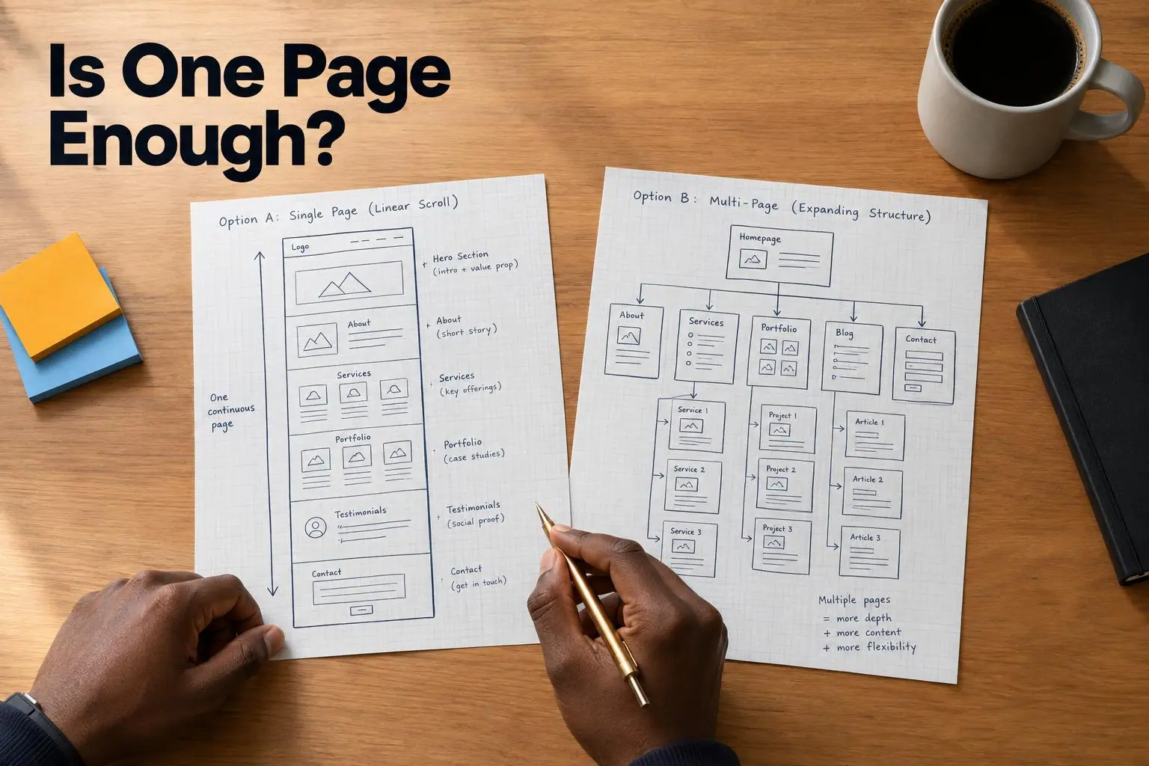
A one-page website is a complete business website built on one main URL. Instead of opening separate Home, Services, About and Contact pages, visitors scroll through sections on the same page.
Its menu normally uses anchor navigation. For example, a Services menu item may take a visitor from yourbusiness.co.bw/#services to the services section lower down the page. These jump links can make a compact site easy to use, especially when the page has a clear order and mobile-friendly sections.
This is different from a multi-page website, where each important topic has its own URL, such as /services/, /about/ or /contact/. It is also different from a complex single-page application (SPA), where JavaScript may change what is displayed without creating distinct page URLs.
One-Page Website vs Landing Page vs Multi-Page Website
These formats can look similar, but they serve different jobs. A one-page business website represents the whole business in a compact format. A landing page is usually a focused destination for a campaign. A multi-page website gives a business room to organise broader information and separate customer journeys.

| Feature | One-Page Website | Single Campaign Landing Page | Multi-Page Website |
|---|---|---|---|
| URL structure | One primary URL with section anchors | Usually one focused campaign URL | Multiple unique URLs for key topics |
| Primary purpose | Present a complete, focused business | Drive one defined action after a campaign click | Explain a broader business, its services and resources |
| SEO potential | Best for a narrow topic set and brand visibility | Usually campaign-led rather than a full organic-search structure | More scope for dedicated service, location and content pages |
| Navigation style | Scroll and anchor links | Minimal, action-focused navigation | Menus and internal links between pages |
| Ideal business stage | Early-stage or single-offer business | Specific promotion, event or ad campaign | Growing business with multiple offers or audiences |
Google Ads describes a landing page as the page a person reaches after clicking an ad; see the Google Ads definition of a landing page. In practice, a landing page should closely support one campaign action, while a one-page business website needs to answer wider questions about the brand, offer and contact process. For a deeper comparison, see website versus dedicated landing page.
When One Page Works Exceptionally Well
A simple one page website can be the smart commercial choice when clarity matters more than volume. It reduces the amount of content, design and decision-making needed to get a credible online presence live.
- You sell one core service: A specialist bookkeeping consultant, photographer or tutor can explain one primary offer, show proof and invite an enquiry without several pages.
- You are validating a new business: A startup can test its message, collect enquiries and refine its offer before investing in a larger content structure.
- You are a solo professional: A consultant with one service area and a WhatsApp-led enquiry process may only need an introduction, service summary, credibility signals and contact options.
- You have a local, focused offer: An event, short-term programme, selected tour package or small portfolio may be easier for visitors to understand on one well-organised page.
- Your launch scope is genuinely tight: A smaller build lets you focus available budget on clear copy, usable mobile layout and reliable contact paths rather than pages you cannot yet maintain.
For example, a new Botswana tour operator offering one signature day experience may be better served by one persuasive page than by thin pages for services it does not yet provide. The page should make the itinerary, price enquiry process, meeting point, trust signals and WhatsApp contact easy to find.
The Hidden Limitations: When One Page Becomes a Liability
A one-page site is not inherently poor for SEO or user experience. The problem begins when a business asks one URL to explain too many unrelated offers, serve several audiences or support multiple marketing campaigns. The result is often a long, unfocused page that is harder to scan, update and promote.
Organic Search and Keyword Constraints
A conventional one-page site can be indexed and can rank for its brand name and relevant searches. However, one URL gives you fewer opportunities to create tightly targeted pages for materially different search intents. A logistics company offering freight, warehousing and customs support, for example, can explain all three on one page, but dedicated pages can give each service a clearer topic, title, message and call to action.
Anchor links such as #services are useful for moving visitors around a page; they do not create separate service pages. This matters even more if a JavaScript application uses URL fragments to load different content views. Google’s URL-structure guidance advises against relying on fragments for distinct content intended to be discovered as separate views.
When you add dedicated pages, connect them with descriptive HTML links that contain real href values. That helps users and search engines discover the site structure, in line with Google’s crawlable-link best practices. More URLs do not guarantee rankings, but they provide a better architecture for genuinely separate topics.
Service and Geographic Scalability
A one-page layout becomes difficult when each service needs its own explanation, evidence, questions and conversion path. It can also become cumbersome when a business serves distinct locations or customer types. Visitors looking for a specific service should not have to scroll through several unrelated sections to decide whether you are relevant.
Long pages can be perfectly usable when they are focused. But adding large galleries, repeated copy, embedded tools and numerous service sections can make a page heavy and tiring to navigate on a phone. Design the first launch mobile-first: compress images, keep headings specific, place contact actions where they are needed and avoid hiding essential information in decorative effects.
Separate pages also make campaign planning easier. A business can send a Google Ads visitor to the service most relevant to the ad, rather than to a general page where the visitor must search for the right section.
Decision Matrix: Do You Need One Page or Multiple Pages?
Use this checklist to choose an architecture based on operational reality, not ambition alone. Start with the smallest structure that can clearly support your current offer, then expand when there is a real business reason.

You probably need a one-page website if…
- You have one core service, product line or clear introductory offer.
- Your main goal is to establish credibility and generate phone, form or WhatsApp enquiries.
- You serve one main audience and do not need different journeys for different customer types.
- You can describe your offer, proof and contact process clearly in a few purposeful sections.
- You are launching, testing demand or working with a tightly defined first-phase budget.
- You can commit to keeping the single page accurate and up to date.
You definitely need a multi-page website if…
- You offer several distinct services that each need detail, proof or a separate enquiry route.
- You need service, location, industry or resource pages for different search and advertising intents.
- You have multiple divisions, such as a logistics firm with transport, warehousing and project services.
- You need an ecommerce catalogue, substantial portfolio, bookings, knowledge content or detailed customer support information.
- Your page is becoming a long sequence of unrelated sections with competing calls to action.
- You expect to publish content or add new offers regularly.
As a practical Lephutshi Developers scope example, its published One-Page Business Launch package starts at P4,500, while its business website option starts from P6,900 for a broader multi-page structure. Those are Lephutshi package starting prices, not Botswana-wide price averages. The cost difference reflects scope: additional page planning, content organisation, design, build work and testing all take time.
What Must Go on an Effective One-Page Website?
A compact site still needs to answer the questions a serious buyer has before they make contact. The objective is not to squeeze everything onto one page; it is to put the most decision-relevant information in a logical order.
- A clear hero section: State who you help, what you offer and the next action. Avoid vague slogans that do not explain the service.
- A concise services section: Describe the core offer, key outcomes and any important boundaries. If you have too many services to explain clearly here, that is a signal to consider more pages.
- Trust signals: Use genuine testimonials, credentials, project examples, affiliations or process details that you can substantiate.
- An about summary: Explain who is behind the business and why the business is equipped to deliver the offer. Keep it relevant to the customer’s decision.
- A simple process or FAQ: Clarify what happens after an enquiry, what information a customer should provide and any frequent concerns.
- Direct contact options: Include a working phone number, email address, contact form and, where it suits the business, a WhatsApp option. Add location information if customers need to visit or meet you.
- Repeated, specific calls to action: Use actions such as “Request a quote” or “Send your requirements on WhatsApp” rather than generic buttons.
Before publishing, test every contact route on a phone and make sure someone can respond promptly to enquiries. For a broader quality checklist, review these essential features for a Botswana small-business website.
How and When to Upgrade to Multiple Pages
You do not need to rebuild simply because your business is growing. Add pages when they solve a clear customer, content or marketing problem. Useful triggers include launching a new service, targeting a distinct audience, opening another location, running service-specific ad campaigns, adding substantial portfolio material or finding that your one page is becoming difficult to scan.

Plan the change carefully. Keep useful content where it still belongs, create clear new page topics and update navigation so visitors can find the right information. If an existing URL is permanently replaced, use permanent redirects and update relevant site references; see Google’s guidance on moving URLs. Redirects help communicate a permanent move, but they do not remove every possibility of temporary search fluctuation.
If your services, audience or content now need distinct destinations, explore web design and development options for a growing business and match the next build to the requirements you actually have.
Making the Right Web Design Choice for Your Business
A one page website design is a strong starting point when your offer is focused and your immediate goal is a credible, conversion-ready online presence. Choose multiple pages when separate services, customer journeys, locations or marketing goals need their own space. Starting small is sensible; staying structurally small after the business has outgrown it is not.
If you are between the two options, Lephutshi Developers can help you assess your service scope, audience, growth plans and budget before you build. You can request a website recommendation based on the stage your business is in now.
Recommended Reading
- Website Design & Digital Marketing Pricing in Botswana
- Do You Need a Landing Page for Google Ads? Website vs Dedicated Landing Page
- 10 Must-Have Features for a Small Business Website in Botswana
FAQ
- Can a one-page website rank on Google?
Yes. A one-page website can rank for its brand name and relevant searches, especially when it has clear, useful content and sound technical implementation. It has less room than a multi-page site to create separately targeted pages for distinct services, locations and search intents. - How much does a one-page website cost in Botswana?
Cost depends on the content, design, functionality and level of custom work required. Lephutshi Developers’ published One-Page Business Launch package starts at P4,500, while its broader multi-page business website option starts from P6,900; these are company package starting prices, not Botswana-wide market averages. - Is a landing page the same as a single-page website?
No. A landing page is usually built around one campaign action, such as submitting a form after clicking an ad. A single-page website is the business’s broader online presence, with sections that introduce the brand, offer, proof and contact details. - Can I add more pages to a one-page website later?
Yes. A one-page site can expand into a multi-page website as your services, content and marketing needs grow. Plan the new page structure carefully, use clear internal links and apply permanent redirects when an existing URL is permanently replaced. - When should a small business choose multiple website pages?
Choose multiple pages when you have several distinct services, audiences, locations or campaign goals that need dedicated explanations and calls to action. A multi-page structure is also more suitable for larger portfolios, ecommerce catalogues and ongoing content publishing.