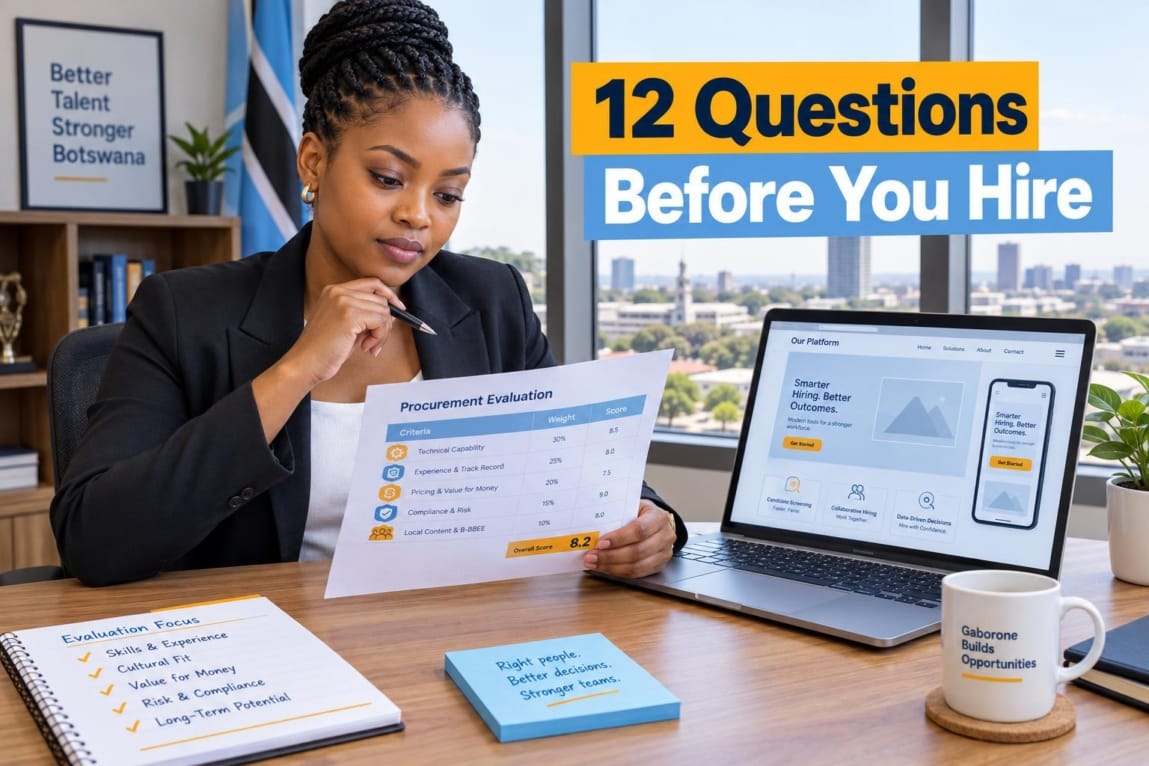

Choosing between website developers in Botswana is not mainly a design decision. It is a business-risk decision: the wrong agreement can leave you without access to your domain, with a slow site, unclear scope, or unexpected support costs after launch. The right developer gives you a website your team can use, manage, and improve.
This guide helps you compare freelancers, studios, and agencies using the same practical criteria. Use the questions and scorecard before accepting a proposal—not after the build has started. You can also compare website development providers in Botswana once you know what evidence to look for.
Quick answer: the five pillars to check before hiring
Before hiring a developer, confirm five things in writing: asset ownership (domain, hosting, files, accounts), technical foundation (mobile, SEO, speed, security, accessibility), scope and revisions, integrations and content responsibilities, and post-launch support. A good-looking proposal is not enough if these responsibilities are vague.
- Own or control your assets: your business should retain access to every account needed to operate the site.
- Specify deliverables: list pages, features, integrations, content, testing, and launch tasks.
- Test the live result: check mobile use, forms, speed, links, and admin access before final sign-off.
- Plan for after launch: agree on bug fixes, updates, backups, response times, and costs.
Define your project: what kind of website do you actually need?
A clear brief helps you compare like with like. Without one, one quote may cover a five-page information site while another includes copy population, enquiry forms, analytics, training, and maintenance.

| Website type | What it is designed to do | Requirements to define |
|---|---|---|
| Corporate or brochure site | Build trust and explain services, locations, and contact options. | Pages, service information, photos, enquiry forms, WhatsApp and who supplies content. |
| Lead-generation site | Turn search, referrals, or campaigns into qualified enquiries. | Offers, calls to action, form routing, tracking, CRM connection and lead-response process. |
| E-commerce storefront | Present products and accept or manage orders. | Product catalogue, payment method, delivery rules, stock process, customer communications and returns workflow. |
| Custom portal or web application | Support a distinct workflow, such as bookings, member access, approvals, or dashboards. | User roles, data fields, integrations, security, testing, support and future development. |
For many SMEs, the most important choice is not “custom versus template”; it is whether the platform can support the required workflow and be maintained within the available budget. Read more about whether WordPress or a custom website fits your business before locking in a technology choice.
12 essential questions to ask before hiring a website developer
1. Who will own the domain, hosting, and website files?
Ask for each asset separately. Your agreement should identify the domain registrant and registrar account, recovery email, renewal responsibility, DNS access, hosting account or cPanel access, website files, source-code repository, CMS administrator account, backups, analytics properties, and third-party integration accounts.

A developer may manage these assets for convenience, but your business should be able to access or transfer them if the working relationship changes. If you use a .bw name, the official Botswana’s .bw domain registry provides registry information. A .bw domain is a choice, not a requirement; the essential issue is documented control and a workable renewal process.
2. Is mobile responsiveness tested on real devices as well as emulators?
Many Botswana customers will first encounter your site on a phone, often using a mobile connection. Ask how menus, forms, tap targets, images, and calls to action are tested on actual devices and common browsers. A layout that looks acceptable in a desktop preview can still be difficult to use on a small screen or slow connection.
3. What technical SEO foundations are included in the build?
Ask for a defined baseline: logical URLs, one clear page topic, semantic heading structure, crawlable internal links, image alternative text where appropriate, sitemap handling, robots controls where appropriate, redirects for a redesign, and structured data only where it genuinely matches the page type. Analytics and Search Console setup should also be stated separately if included.
A sound build makes it easier for search engines to access and understand a site; it does not guarantee rankings, traffic, or leads. Google Search Essentials provides the official baseline for search eligibility and people-first content.
4. How do you handle web accessibility and coding standards?
Ask what the team tests for: semantic HTML, keyboard navigation, visible focus states, useful form labels, meaningful alternative text, readable contrast, and error messages that help users recover. These details improve usability for many people, not only visitors using assistive technology.
W3C’s WCAG accessibility guidance describes testable accessibility criteria under four principles: perceivable, operable, understandable, and robust. Confirm the conformance target and testing approach rather than assuming a developer’s use of the word “accessible” means every criterion has been checked.
5. What CMS or technology stack will you use, and why?
The answer should connect to your needs. A CMS such as WordPress can suit a content-led business that needs staff to edit pages. A custom framework may suit a complex workflow. Be cautious of a proprietary system that makes it difficult to export content, change support providers, or add ordinary features without the original vendor.
Ask who can edit text, images, products, and forms after launch; what licences or plugins are needed; and what happens if you later move hosts or developers.
6. What third-party integrations are included?
List integrations, do not assume them. Depending on the project, these may include a WhatsApp button, maps, email marketing, a CRM, booking software, Google Analytics, Search Console, payment services, stock tools, or delivery workflows. For an online shop, confirm who configures payment, order notifications, and the operational steps your team must follow after an order arrives.
7. Exactly what counts as a revision during the build?
Ask for the revision process in the proposal. A correction to spelling or button colour is different from replacing a page layout after approval; adding a new booking function is a scope change, not a revision. Define the number of feedback rounds, who consolidates feedback, approval deadlines, and how new work is estimated and approved.
8. How will website speed and Core Web Vitals be optimized?
Ask how the developer will handle image sizing and modern formats such as WebP, caching, fonts, scripts, hosting response time, and real-device testing. Request measurement before launch rather than a vague promise that the site will be fast.
Google’s Core Web Vitals guidance describes metrics for loading, responsiveness, and visual stability: LCP, INP, and CLS. They are useful user-experience measurements, not a standalone ranking or conversion guarantee.
9. Who writes and enters the website content and assets?
Content is often the real launch dependency. Confirm who supplies or writes copy, photographs, logos, staff bios, product data, pricing, legal pages, testimonials, and translations. Set a content deadline, a file-sharing method, and a decision-maker. If the developer is expected to enter content, specify how many pages or products are included.
10. What security measures and backup protocols are implemented?
HTTPS is necessary but it is not a complete security plan. Ask who owns updates, how administrator access is limited, how plugins or dependencies are patched, where backups are stored, how often they run, whether restores are tested, and who handles an incident. Security needs continuing attention after launch.
The OWASP Top 10 web-application security risks is a useful high-level reminder that access control, configuration, authentication, software supply chain, and logging all matter. It is not, by itself, a security audit or proof that a site is secure.
11. What happens on launch day, and what warranty is provided?
Request a launch checklist: DNS changes, SSL checks, form and email testing, payment tests where relevant, redirects, analytics verification, mobile checks, and monitoring for broken pages. Define a post-launch bug-fix period and distinguish defects in agreed work from later content changes or feature requests. The duration and terms should be negotiated and written into the agreement.
12. What are the ongoing maintenance costs and service-level expectations?
Ask what recurring hosting, licence, support, update, backup, and monitoring costs apply. If support is offered, define what counts as an emergency, the communication channel, expected response windows, included hours, and rates for additional work. A maintenance arrangement can be a monthly retainer or pay-as-you-go support; neither is automatically right for every business.
Use these questions to compare what each development team is actually offering, not just the headline price.
Freelancer vs. web development agency: which fits your business?
| Provider type | Cost indication | Best suited for | Key advantages | Main risks |
|---|---|---|---|---|
| Solo freelancer | Often lower overhead; quote depends on scope. | Focused, lower-complexity projects with clear requirements. | Direct communication and flexibility. | Limited capacity, continuity if unavailable, and narrower specialist coverage. |
| Boutique studio | Scope-based; may sit between solo and larger agency models. | Businesses needing a small team and hands-on delivery. | Broader skills with a more personal working relationship. | Capacity can still be constrained during busy periods. |
| Full-service agency | May include more planning and specialist roles. | Multi-part projects involving design, development, content, marketing, or ongoing support. | Process, role coverage, and continuity planning. | Higher overhead or a less direct relationship with the person doing each task. |
| Offshore contractor | Can appear competitive, but total coordination cost varies. | Well-specified work with strong internal project management. | Specialist availability and extended time-zone coverage. | Communication gaps, support handover, payment, and accountability complexity. |
Choose based on the consequences of delay, the complexity of the work, and the support you need after launch—not on provider labels. Explore the deeper freelancer versus agency trade-offs in Botswana if you are weighing capacity and continuity.
How to evaluate a developer’s portfolio beyond visual appearance
A polished screenshot only shows the surface. Ask for live URLs and test the work as a prospective customer would. It is reasonable to expect confidentiality around some client work, but a provider should still be able to explain relevant experience and their role in a project.
- Open the site on your phone and test the menu, forms, phone links, and WhatsApp action.
- Check whether the value proposition and next step are clear without searching through the page.
- Try a few key paths: service enquiry, product search, checkout, booking, or account sign-in, as relevant.
- Look for broken links, outdated information, intrusive pop-ups, layout shifts, and hard-to-read text.
- Ask whether the work is live, what the developer delivered, and whether the same team will work on your project.
- Consider fit: a beautiful restaurant site does not prove capability for a secure member portal or a large product catalogue.
You can review live web-development portfolio examples and apply these same checks to them and every provider on your shortlist. Portfolio work demonstrates approach, not a promise that another project will produce identical outcomes.
Critical red flags during vendor selection
- A vague proposal: “website development” without page, feature, content, testing, and handover detail makes fair comparison impossible. Request a deliverables list.
- No ownership or access terms: refusal to provide administrator access or explain account control can create dependency. Put assets and credentials in the agreement.
- An unrealistically low fixed quote: it may exclude content, integrations, licences, testing, revisions, or maintenance. Ask what is excluded and what change requests cost.
- No formal agreement: email conversations are not a substitute for clear scope, payment milestones, acceptance criteria, ownership, and support terms. Use a written agreement suited to your circumstances.
- Guaranteed number-one rankings: no ethical provider can guarantee a specific Google position. Ask what SEO work is included and how progress will be measured instead.
- Only visual evidence: if no live work, process explanation, or relevant technical evidence is available, reduce the score for delivery confidence.
The website developer selection scorecard
Score each provider from 1 (weak or unclear) to 5 (strong, specific, and documented). Multiply each score by the weight, then total the columns. The purpose is not false precision; it is to stop one attractive mock-up or low quote from overpowering the factors that affect ownership and long-term reliability.

| Assessment criteria | Weight (1–5) | Developer A score | Developer B score | Key evaluation notes |
|---|---|---|---|---|
| Asset ownership and handover | 5 | Accounts, credentials, files, backups, transfer terms. | ||
| Scope and revision clarity | 5 | Pages, features, exclusions, approvals, change process. | ||
| Mobile, accessibility, SEO and speed approach | 4 | Specific testing and technical deliverables, not slogans. | ||
| Relevant portfolio evidence | 4 | Live, functional work similar to your project. | ||
| Integrations and operational fit | 4 | Payments, CRM, WhatsApp, tracking, content workflow. | ||
| Communication and project management | 4 | Named contact, milestones, feedback process, reporting. | ||
| Security, backups and maintenance | 4 | Update ownership, restore process, support terms. | ||
| Value for investment | 5 | Compare included outcomes and risk reduction, not price alone. |
Before scoring, give every provider the same written brief. That makes differences in their recommendations useful: one may identify a missing requirement, while another may simply have omitted it.
Conclusion: make an informed investment in your digital presence
The best website developer for your business is the one whose proposal makes ownership, delivery, technical quality, and support clear—and whose approach fits the website you actually need. Gather your requirements, use the 12 questions in every discovery call, test live portfolio work, and score comparable proposals before deciding.
If you want a second view of your brief or proposal, Lephutshi Developers can help you turn it into a clearer scope. You can also review Lephutshi’s current website package starting points; they are starting points, and the final quotation should reflect your required functionality, content, integrations, and support.
Recommended Reading
- Top 10 Web Design Companies in Botswana & How to Choose the Best One
- Custom Website vs. WordPress for Botswana Businesses: Which to Choose?
- Freelance Web Developer vs. Agency in Botswana: Pros and Cons
- 10 Must-Have Features for a Small Business Website in Botswana
FAQ
- How much does it cost to build a website in Botswana?
The cost depends on the scope rather than a single market figure. Key factors include the number of pages, custom design, content creation, CMS choice, e-commerce requirements, integrations, hosting, licences, and post-launch support. Ask every provider to separate one-off build work from recurring costs so you can compare proposals properly. - How long does it typically take to build a business website?
A straightforward business site can take several weeks, while e-commerce sites and custom applications can take longer. Timing depends on discovery, design approval, development, content delivery, integrations, testing, revisions, and launch readiness. Agree on milestones and identify who must supply content or approvals to avoid avoidable delays. - Can ChatGPT or AI tools build my business website instead?
AI tools can help draft copy, plan pages, generate basic code, and speed up routine tasks. They do not replace decisions about brand architecture, user journeys, local payment or business integrations, security, testing, ownership, and long-term maintenance. Treat AI as an assistant and ensure a capable person remains accountable for the finished site. - What essential elements must every business website include?
Every business website needs a clear value proposition, mobile-friendly layout, visible contact details or WhatsApp access, service or product information, secure HTTPS, and clear next steps such as an enquiry, call, booking, or purchase. It should also have accurate content, working forms, and a process for responding to enquiries. See these small-business website features to include for a fuller requirements checklist.