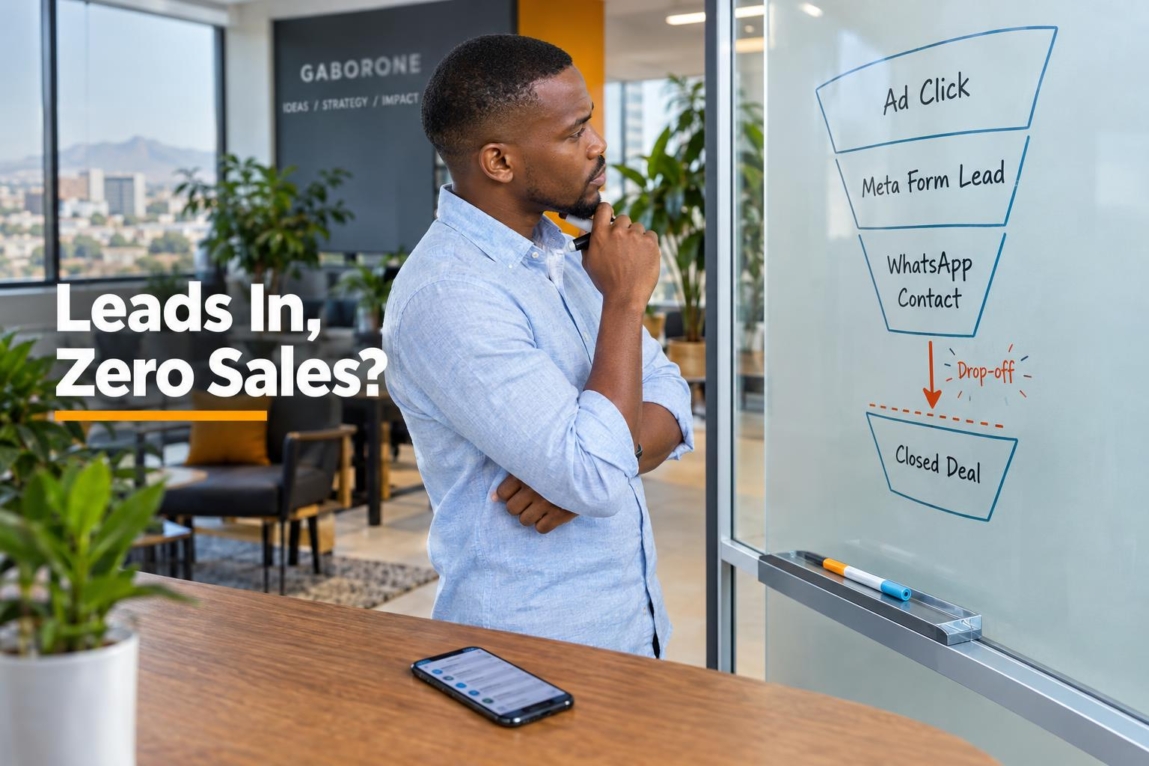

Getting form submissions, messages or clicks but no paying customers is frustrating—especially when Meta Ads Manager says your campaign is working. If your Facebook ads are not converting into sales, the problem may sit anywhere between the ad, the lead form, the WhatsApp reply, the quote and the final decision. This guide helps Botswana businesses find the break and fix it.
Direct answer: why leads are not sales
Facebook ads generate leads without producing sales when the ad promise, lead qualification and sales follow-up do not line up. A low-friction instant form can collect contact details from people who are curious, unavailable, outside your budget range or no longer interested by the time your team responds.
Do not assume the algorithm is the only problem. First identify whether you have a targeting problem, an offer problem, a form-quality problem, a response problem or a closing problem. Then measure progress from reported lead to qualified prospect, appointment or quote, and finally paid customer.
The lead-to-sale reality: why Meta leads are not revenue
Meta reports a lead when a person completes the action selected for the campaign, such as submitting an Instant Form. That is useful information, but it is not proof of commercial intent, affordability or a completed sale.
- Reported lead: A form submission or tracked enquiry in Meta.
- Contacted lead: A person your team has successfully reached.
- Qualified lead: A reachable prospect who fits your location, need, timing and budget criteria.
- Sales-accepted lead: A qualified prospect a salesperson agrees is worth pursuing, often through a call, site visit, booking or quote.
- Closed revenue: A customer who has accepted the offer and paid or committed under your normal sales process.
A campaign can look cheap at the reported-lead stage and still be expensive at the customer stage. Directional Facebook lead-campaign benchmark data can help provide context for upper-funnel click and lead metrics, but it is not Botswana-specific and cannot tell you whether your leads will become customers. Your own cost per qualified lead and customer acquisition cost are the decision-making numbers.
Diagnose the 5 critical funnel breakdown points

Review the journey in order. Fixing a later-stage problem will not rescue a weak earlier stage, and changing audiences will not solve a quote that surprises every prospect.
- Targeting: Are the people seeing the ad likely to need, afford and access the service?
- Promise: Does the ad set the same expectation as your actual scope, availability and price discussion?
- Capture: Does the form collect enough information to identify a serious prospect without creating needless friction?
- Response: Does someone receive, acknowledge and contact the lead quickly through the right channel?
- Close: Does the sales process build trust, clarify the next step and handle price or timing objections?
Ask your sales team to tag the reason for every lost lead. Useful tags include invalid number, no answer, wrong location, no budget, requested service unavailable, price objection, quote pending and chose another provider. Without these tags, “bad leads” becomes a guess rather than a diagnosis.
Are your reported leads real and qualified?
Some apparently fake leads are genuine people who submitted quickly, forgot the ad or used contact information they do not check often. Meta forms can use information a person has given Meta to pre-fill answers, so a phone number or email may be no longer preferred. Treat this as a verification issue, not proof that every lead is fraudulent.
Meta offers form experiences such as More Volume, Higher Intent and Rich Creative. Its lead-generation form guidance also describes tools such as conditional questions, CRM lead retrieval and sending downstream outcomes back through Conversions API or Conversion Leads workflows. Check the current labels and options in Ads Manager before publishing or changing a campaign, because platform controls can change.
For many service businesses, start by adding one or two questions that change the sales conversation: preferred area, service required, approximate budget band, property type or intended start date. Do not turn a short enquiry into a long application. The goal is to separate obvious mismatches while preserving a simple mobile experience.
Dealing with “I never filled out this form”
Lead memory can be weak when an ad is skimmed in a feed and a form is completed in seconds. Your first message should identify your business, name the service and remind the person what they requested. Richer form creative, a clear thank-you screen and an immediate confirmation message can make the action more memorable.
If you need broader setup context after reviewing your form, see this Facebook Ads guide for Botswana small businesses.
The follow-up breakdown: WhatsApp, phone calls and response latency

For many Botswana SMEs, the critical handover is from an ad lead to a useful WhatsApp conversation or phone call. Email alone can be easy to miss on a mobile-first buying journey. Build the response process before increasing campaign budget: a lead alert, a named owner, a first-response script and a backup action when there is no reply.
Respond as soon as your team can do so properly. Foundational research on the short life of online sales leads found that online enquiries lost qualification potential as businesses delayed contact; it is not a Botswana Facebook-lead benchmark, but it supports making prompt response an operational priority. A practical internal target is an acknowledgement within 5 to 15 minutes during business hours, followed by a genuine conversation—not a universal guarantee of conversion.
| Channel | Best use | Strength | Watch for |
|---|---|---|---|
| Phone call | Urgent needs, complex services and quick qualification | Fast two-way clarification | Calling repeatedly without context can feel intrusive; unanswered calls need a follow-up message. |
| WhatsApp chat | First acknowledgement, reminders, photos, location and quote follow-up | Convenient written record and easy continuation | Use a business profile and identify the enquiry; do not send a vague “Hi” message. |
| Formal quotes, specifications and longer documents | Useful documentation | May be slower for first contact and should not be the only response route. |
A simple first WhatsApp message can be: “Hello [Name], this is [Name] from [Business]. You requested information about [service] through our Facebook advert. Are you available for two quick questions so we can advise or quote accurately?” If there is no reply, try one helpful follow-up and, where appropriate, a call. Record every attempt in the same lead record.
Landing pages vs Instant Forms: where trust is won or lost

Instant Forms reduce friction and can be suitable when the offer is simple, the next step is clear and your team can qualify quickly. A dedicated landing page is often the better choice for higher-value, unfamiliar or trust-sensitive services where a prospect needs to understand scope, see proof, review practical details and decide whether the price range is realistic before enquiring.
An external page must earn the extra click. It should load well on a typical phone and connection, state the offer clearly, show real proof where available, explain the next step and make contact easy. Google’s mobile page-speed research supports the broader relationship between slower mobile pages and higher abandonment risk, although its data is not a Botswana conversion forecast. Test your actual page, form and WhatsApp button on mobile rather than relying on a generic speed threshold.
If the diagnosis points to weak service-page trust or a poor mobile journey, review website and landing-page development options. A redesign alone will not repair weak targeting or slow lead handling, but the right page can give serious buyers the context they need before they submit.
The 12 Facebook lead-to-sale problems: symptom, cause and fix
| # | Observable symptom | Likely root cause | Operational fix |
|---|---|---|---|
| 1 | Wrong numbers or dormant emails | Potentially pre-filled contact details are no longer preferred | Ask for verification or manual entry where appropriate; confirm contact details in the first message. |
| 2 | Prospects disappear when price is discussed | The ad creates interest but gives no price context or scope | State a starting point, package qualifier or key scope boundary where suitable. |
| 3 | Leads are contacted a day later | No alert, ownership or response routine | Route leads to a responsible person and set a business-hours response target. |
| 4 | Many enquiries, few suitable buyers | Audience is too broad or the creative attracts curiosity | Refine geography, messaging and exclusions; test audience changes one at a time. |
| 5 | Lead expects something different | Ad promise and sales script do not match | Use the same service name, inclusions and next step in both. |
| 6 | Sales team must discover basic fit on every call | No meaningful qualification fields | Add one or two decision-useful questions, such as area or required service. |
| 7 | Calls go unanswered | Phone-only contact strategy or no context before calling | Send a recognisable WhatsApp introduction, then call when invited or appropriate. |
| 8 | Lead submits but takes no next action | Thank-you screen gives no clear expectation | Explain when and how you will respond; offer a clear WhatsApp or booking next step. |
| 9 | Prospects ask if the business is legitimate | Insufficient online trust signals | Use accurate business details, real work samples where available, clear service information and consistent contact channels. |
| 10 | Chats stall after “How can I help?” | Passive, unstructured sales messaging | Use a short discovery sequence: need, location, timing, budget fit and next action. |
| 11 | Sales staff do not see leads promptly | Disconnected form, inbox and CRM process | Test routing daily, assign ownership and log timestamps from submission to first reply. |
| 12 | CPL falls but sales do not improve | Campaign is optimised only for lead volume | Feed qualified outcomes back where your setup allows and judge changes by downstream quality. |
Do not change all 12 areas at once. Start with the failure that produces the largest visible loss: invalid details, slow response, poor qualification or a price surprise. Keep a simple change log so you can tell what improved lead quality.
Metrics that matter: move beyond cost per lead
Cost per lead (CPL) is only the first calculation. Use a shared spreadsheet or CRM report that joins Meta spend to sales outcomes.
- Cost per qualified lead (CPQL) = ad spend ÷ qualified leads.
- Cost per appointment or quote = ad spend ÷ completed appointments or issued quotes.
- Customer acquisition cost (CAC) = ad spend ÷ new customers attributable to the campaign.
- Lead-to-sale rate = new customers ÷ reported leads × 100.
- Break-even CPA: the most you can spend to acquire a customer while retaining the margin your business requires.
Also track response time, contact rate, qualification rate, quote acceptance rate and loss reason. If your CRM and campaign setup support it, sending qualified or closed outcomes back to Meta can help the platform learn from better downstream events. It still requires enough accurate sales data and does not remove the need for human follow-up.
When to fix the ads versus overhaul the sales process
Evidence tells you where to work. The campaign is the first place to investigate when many records have unusable details, prospects do not recognise the service, the leads fall outside your service area or the ad copy attracts a different need from the one you sell.
The sales process needs attention when prospects recognise the advert, can be reached and broadly fit the offer, but they receive slow replies, unclear answers, mismatched quotes or no structured next step. If both patterns appear, work on the handover first: an excellent campaign cannot compensate for a missed lead notification, and a good sales team cannot consistently close the wrong audience.
Businesses whose evidence points to campaign setup, tracking, audience alignment or optimisation can explore PPC campaign management and optimisation support. Treat this as an evidence-led audit option, not a replacement for internal pricing discipline and lead response.
Action plan: restructure your funnel for actual sales
- Audit the last 20 to 50 leads. Mark each as contacted, qualified, quoted, won or lost, and write the loss reason. This reveals the largest leak.
- Adjust the capture step. Check your form type, add one or two useful qualifiers and make the thank-you screen state the response channel and timing.
- Create a response protocol. Assign a lead owner, enable lead alerts, use a recognisable WhatsApp introduction and define the call and follow-up sequence.
- Align the message. Compare the ad, form, WhatsApp script and quotation line by line. Service, location, inclusions, timing and price context should not change unexpectedly.
- Review weekly. Optimise against qualified leads, quotes and customers—not only the cheapest form completion.
Facebook ads are not converting when one or more handovers break between attention and payment. Find the exact stage, repair that stage first and measure whether more reported leads become reachable, qualified prospects and customers.
If you need help connecting campaign optimisation with a stronger landing page, tracking or lead-routing process, Lephutshi Developers can help you assess the practical gaps and request a website or digital marketing quotation for appropriate implementation support.
Recommended Reading
- Facebook Ads for Small Businesses in Botswana: PPC Guide
- Web Design Botswana: Website Development and Packages
FAQ
- Why are my Facebook ads getting clicks but no sales?
Clicks show that people noticed the advert, not that they are ready or able to buy. Check whether the ad promise matches the offer, whether the landing page or form creates trust, and whether your team responds quickly with a clear next step. - Why am I getting fake leads on Facebook?
Some leads may contain contact information that is no longer preferred or may come from people who completed a quick form without strong intent. Use clear form language, consider Higher Intent or richer form options where available, add light qualification and confirm the enquiry in your first message. - How fast should I contact a Facebook ad lead?
Contact a lead as soon as your team can respond helpfully, ideally with a quick acknowledgement within 5 to 15 minutes during business hours. Fast follow-up is a practical target rather than a guaranteed rule; the important point is to avoid long, unmanaged delays. - Should I use Facebook Lead Forms or send traffic to my website?
Use Lead Forms when the offer is simple and your team can qualify promptly. Send traffic to a landing page when buyers need more proof, service detail, price context or trust before they enquire, especially for higher-value or complex services.