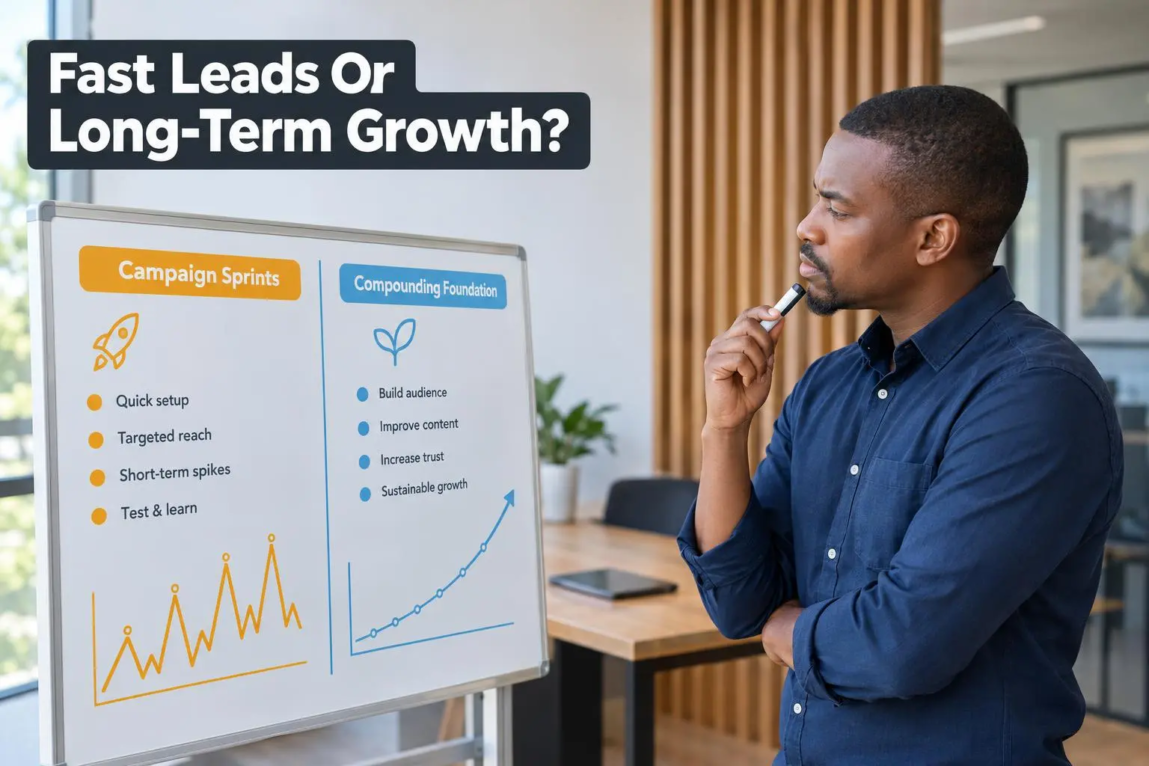

Choosing between SEO and Google Ads can feel risky when every pula in your marketing budget needs to produce a result. Google Ads can put your business in front of active searchers quickly, while SEO builds the website and local visibility that can keep attracting customers over time. This guide compares SEO vs Google Ads Botswana businesses can use, then helps you choose based on your timeline, working capital, search demand and customer value.
The Quick Answer: SEO vs Google Ads for Botswana Businesses

Google Ads is usually better when you need enquiries quickly, want to test demand, or are running a time-sensitive offer. SEO is usually better for long-term cost efficiency, local credibility and a more durable stream of organic enquiries. Neither channel is automatically better for every business: the right choice depends on how soon you need revenue, what you can consistently invest, how often customers search for your service, and what a new customer is worth to you.
Understanding the Core Difference: Paid Visibility vs Digital Real Estate
Google Ads is paid search. You are effectively renting prominent visibility when someone searches for relevant terms. SEO is organic search: you are improving the website, content and local business signals that help Google understand and surface your business without charging you for each organic click.
The distinction matters commercially. Paid search can switch on quickly but requires ongoing media spend. Organic search takes longer to earn, but a useful page or strong local presence can continue creating opportunities after the initial optimisation work is complete.
How Google Ads Works for a Local Business
With Google Ads, you choose search terms, locations, audiences and a budget. When an eligible person searches, Google runs an auction to decide which ads appear and where. Your bid matters, but it is not the only factor: ad relevance, landing-page quality, expected impact of assets, competition and search context also affect the outcome. Google explains how the Google Ads auction works in detail.
For example, a Gaborone electrician may bid on a service-focused query and direct the click to a page with a clear phone number, service area and booking option. The business pays when someone clicks, not merely when the ad is shown. When the daily or monthly budget is exhausted, or the campaign is paused, that paid visibility stops.
How SEO Works for a Local Business
SEO improves the foundations that make a website easier for search engines to crawl, index and understand: technical health, useful service pages, clear page structure, location relevance and trustworthy business information. Google’s SEO Starter Guide describes these foundational practices, though following them does not guarantee a particular ranking.
For a local business, SEO also includes claiming and managing a Google Business Profile, keeping contact and location details accurate, and making it easy for customers to call, request a quote or message the business. Unlike an advert, a well-built service page and a credible local presence can build value over time. They still need maintenance, accurate information and a website that converts visitors into real enquiries.
Direct Comparison: Speed, Cost, Longevity, and Intent

| Factor | Google Ads (PPC) | Search Engine Optimisation (SEO) | Best Fit for Botswana SMEs |
|---|---|---|---|
| Time to first lead | Potentially soon after a properly configured campaign launches, if demand and conversion paths exist. | Usually slower; pages and local signals need time to be discovered, assessed and improved. | Ads for urgent demand; SEO for planned, sustained acquisition. |
| Cost model | Ongoing spend per click, plus campaign management and landing-page work where needed. | Investment in technical work, content, local visibility and ongoing improvement. | Choose the model your cash flow can support consistently. |
| When spending pauses | Traffic from ads normally stops. | Established pages may retain visibility, although rankings can change and maintenance still matters. | SEO for building a longer-lived acquisition asset. |
| Trust and click behaviour | Prominent placement and message control. | Organic and map results can strengthen credibility during research. | Use both when customers compare providers before contacting one. |
| Local intent capture | Useful for tightly targeted services, promotions and search testing. | Useful for Maps, branded discovery and recurring location-based searches. | Local SEO for persistent service-area visibility; Ads for immediate campaigns. |
Speed: Ads can begin receiving clicks after setup and approval, but clicks are not the same as qualified leads. SEO is slower because Google must discover the work and evaluate it against other available results. Treat any timeline as a planning assumption, not a promise.
Cost: PPC creates a visible, controllable media cost, but a low daily budget may not generate enough qualified activity to learn from. SEO does not make search free; it shifts investment towards website quality, content, local optimisation and ongoing refinement rather than a charge for every visit.
Intent: Google Ads is strong for immediate transactional searches such as a person looking for a supplier, booking or urgent service. SEO can capture those searches too, while also supporting earlier commercial research, branded searches and local discovery.
Measure Outcomes, Not Just Traffic
Both channels can look busy while failing to create profit. Set up measurement for the actions that matter: qualified calls, WhatsApp conversations, quote requests, bookings, purchases and, where practical, closed sales. Google Ads allows businesses to track calls, enquiries and sales as conversions; the important business question is whether the resulting customer acquisition cost is acceptable relative to gross margin and lifetime value.
The Botswana Context: Local Search Volume and Platform Realities
Botswana search demand is not uniform. A broad local service may have enough recurring searches to justify sustained SEO and Google Business Profile work, while a specialised B2B offer may have too few searches for a large always-on campaign. Validate demand before committing: use keyword research, Search Console data where available, campaign testing and actual enquiry quality rather than assuming a term has high volume.
For location-dependent businesses, the map results can be as important as the standard organic listings. A customer looking for a nearby provider may compare business details, reviews, directions and contact options before visiting a website. The factors behind this visibility are worth understanding; this guide explains what influences Google Maps rankings without treating a Maps position as guaranteed.
Mobile readiness also deserves attention. BOCRA reported mobile broadband subscriptions rising from 2,910,507 in March 2024 to 2,985,563 in March 2025 in BOCRA’s 2025 annual report. That does not prove every search is mobile, but it is a practical reason to ensure landing pages load well, phone buttons work, forms are short and WhatsApp or call handling is reliable.
When budgeting for ads in BWP, confirm the account setup before committing. Google states that available payment methods depend on the account country and currency, so review Google Ads payment-method guidance and check any relevant bank charges. Do not assume a particular billing currency or payment option will apply to every Botswana account. Business Profile verification options can also vary by business type, region and other information Google evaluates; use Google’s Business Profile verification guidance when preparing your profile.
When Google Ads Wins for a Botswana SME

Google Ads is often the stronger first move when the business needs a faster route to test or capture demand and can afford to keep the campaign running long enough to learn.
- Immediate revenue need: An emergency repair service, last-minute accommodation availability or an event supplier with a near-term booking window cannot wait for organic rankings to develop.
- New offer validation: A business can test which service wording, locations and offers produce serious enquiries before investing heavily in pages and content.
- High-value transactions: A service with sufficient margin or repeat value may be able to absorb paid acquisition costs, provided calls and sales are measured rather than assumed.
- Seasonal or limited campaigns: Promotions, dates, stock availability and launches can be targeted quickly, then paused when the campaign ends.
Ads are not a shortcut around weak operations. Before launch, make sure the landing page answers the searcher’s need, shows a clear offer, includes credible business details and routes enquiries to someone who can respond promptly. A campaign that sends clicks to a vague homepage often spends money without producing enough useful information.
When SEO Wins for a Botswana SME
SEO is often the better strategic investment when customers search for the same services month after month and the business wants to reduce dependence on continually buying each visit.
- Cash flow cannot support continuous click spend: Building useful service pages and local visibility may be more sustainable than relying on a daily advertising budget.
- Location affects the purchase: Shops, practices, hospitality businesses and service-area providers can benefit from accurate local information, Maps visibility and a strong business profile.
- Customers research before choosing: Professional services and B2B suppliers often need clear, helpful pages that answer questions and build confidence before an enquiry.
- Demand is steady: A predictable service category gives SEO assets more opportunity to compound over time.
Google says local results are mainly based on relevance, distance and prominence; businesses cannot pay Google for a better local ranking. Read Google’s local ranking guidance for the platform view. In practice, the goal is not to chase a guaranteed map position, but to make your business details complete, relevant and credible for the searches you want to earn.
A complete Business Profile is a valuable foundation, but it does not replace a useful website. If local SEO is your likely fit, start with optimising a Google Business Profile for local SEO, then assess your service pages, technical setup and conversion path. Businesses ready to scope sustained work can also review Botswana SEO services for long-term search growth.
The 4-Pillar Decision Framework: How to Choose Your Channel
Use these four pillars before deciding where the next marketing pula should go.
- Cash-flow runway: Do you need credible enquiries this week, or can you invest for the next three to six months? If the need is immediate, paid search may be necessary while SEO develops. If you have patience and steady demand, SEO can be the stronger base.
- Monthly working capital: Can you fund clicks, campaign management, landing-page improvements and conversion tracking consistently? A small test can be useful, but a budget that ends before enough data is collected may not answer the real question. SEO also needs consistent investment, but its costs are directed towards assets that can keep working after publication.
- Search demand: Are people actively searching for your service in the locations you serve? Check query data first. Very low demand may require referrals, partnerships, direct sales or social channels alongside search marketing.
- Customer lifetime value: What is a new customer worth after delivery costs, margin, repeat work and referrals? If one customer creates substantial profit or repeat revenue, a higher acquisition cost may be rational. If margins are thin and customers buy once, paid clicks need tighter control.
A simple decision rule: choose Ads first when urgency and customer value are high; choose SEO first when demand is steady and you need a durable acquisition base; use both when you need leads now and have the capacity to build for later. To separate media budget from management, SEO and website work, you can compare SEO, Google Ads and integrated growth-package costs. These are Lephutshi pricing structures, not Botswana market averages.
The Hybrid Strategy: How Growing Businesses Combine Both
For many growing businesses, organic search vs paid search is a sequencing decision rather than a permanent either-or choice. Ads can capture immediate intent and reveal the phrases that bring serious leads. SEO can then build service pages, local relevance and site quality around validated demand.
A Practical 90-Day Approach
- Days 1–30: establish the baseline. Confirm services, service areas, offers, conversion actions and lead handling. Launch a tightly focused paid search test if immediate enquiries are required. Fix obvious website barriers, claim the Business Profile and ensure phone, form and WhatsApp paths work.
- Days 31–60: learn from real searches. Review search terms, call quality, form enquiries and sales outcomes. Exclude irrelevant queries, improve the landing page and identify the services and locations that deserve dedicated organic pages.
- Days 61–90: build durable visibility. Publish or improve priority pages, strengthen local details and continue only the paid campaigns that produce commercially useful data. Do not cut ads solely because an SEO page was published; reduce or redirect budget when organic visibility and lead quality demonstrate that it is sensible.
This approach avoids two costly mistakes: funding ads indefinitely without learning from them, and waiting for SEO while ignoring urgent demand. It also gives the business a clearer basis for future budget decisions.
Making the Strategic Move for Your Business
SEO vs Google Ads Botswana businesses should choose is not a contest between a modern channel and an old one. Choose Google Ads when speed, testing or short-term demand capture matters most. Choose SEO when your goal is lasting local visibility and lower reliance on paid clicks. Before funding either, check that your website has a clear offer, credible business information, a mobile-friendly enquiry path and a process for responding to leads.
If you want an objective view of your channel readiness, Lephutshi Developers can help you assess demand, website conversion paths, local visibility and budget priorities through a tailored marketing and growth-package review.
Recommended Reading
- Google Maps Ranking Factors: What Influences Local Rank?
- How to Optimize Google Business Profile for Local SEO
- SEO Services Botswana: Organic Search Growth
FAQ
- Are Google Ads better than SEO for a new business?
Google Ads can be better for a new business that needs fast market feedback and early enquiries, provided it has a clear offer and a usable landing page. SEO should still begin early because it builds the website and local visibility needed to avoid permanent reliance on paid clicks. - How long does SEO take to produce leads compared to Google Ads?
Google Ads may generate qualified enquiries within 24 to 48 hours of a properly configured launch, while local SEO often needs three to six months of consistent technical, on-page and local visibility work to gain traction. These are planning expectations, not guarantees; results depend on demand, competition, website quality and lead handling. - Can I run Google Ads without having an SEO strategy?
Yes, you can run Google Ads without a full SEO programme, but weak landing pages can reduce relevance and conversions while making paid traffic less efficient. Foundational SEO, clear service information and a fast, mobile-friendly page support better paid-search decisions. - Which option delivers better long-term ROI for small businesses in Botswana?
SEO often delivers stronger long-term ROI because established organic visibility does not incur a per-click charge. Google Ads offers more immediate control and can be the better short-term choice when speed, testing or seasonal demand matters.