
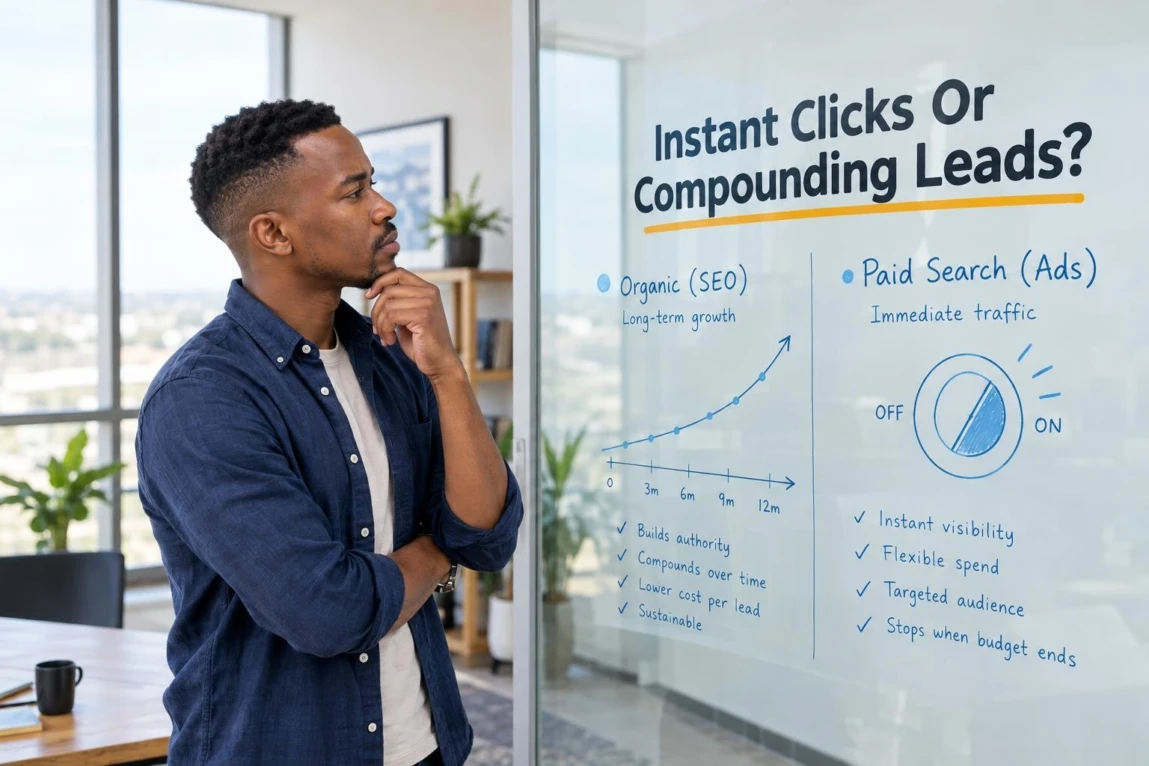

Choosing between SEO and Google Ads is a capital-allocation decision: do you need enquiries quickly, or can you invest in search visibility that may reduce dependence on paid clicks over time? For Botswana SMEs with limited cash flow, the right answer depends on your sales urgency, margins, website readiness, search demand, and ability to follow up leads.
This guide compares SEO vs Google Ads for small business growth without treating either channel as a universal winner. You will learn what each channel costs, how quickly it can produce useful data, what affects lead quality and when a combined approach is commercially sensible.
Quick Answer: Should Your Small Business Choose SEO or Google Ads?

Choose Google Ads when you need to test demand or generate qualified traffic this month, have a clear offer and can afford ongoing ad spend. Choose SEO when you can invest patiently in your website, local visibility and useful content to build a durable source of discovery. Use both when immediate lead generation can fund a longer-term organic search strategy.
Google Ads is rented visibility: traffic can begin soon after a campaign is approved and funded, but it stops when the budget stops. SEO is asset building: it usually takes longer to earn meaningful visibility, but strong pages can continue attracting relevant visitors without a charge for every click. Neither channel can fix an unclear offer, a weak website or slow lead follow-up.
How SEO Works for Small Business Growth

SEO is the work of making your website easier for Google to discover, understand and consider useful for relevant searches. It includes technical accessibility, clear service pages, locally relevant information, helpful content, credible business signals and a straightforward enquiry journey. Google’s SEO Starter Guide describes SEO as improving a site’s presence in Search rather than paying Google for rankings.
For a Gaborone accountant, for example, SEO may mean a fast mobile-friendly site, a clear page for each service, accurate contact details, a maintained Google Business Profile and useful answers to questions prospective clients search before making contact. For a B2B supplier, it may mean detailed product or capability pages that help a procurement team assess fit.
The commercial value is cumulative. A well-built service page, local profile, and supporting content can keep being found after publication, although they still need maintenance as services, competitors, and search behavior change. SEO is not a one-off technical task, and following guidance does not guarantee indexing, rankings, or leads. For a deeper local foundation, see how SEO supports digital marketing growth in Botswana.
How Google Ads Works for Immediate Acquisition

Google Ads places eligible adverts around searches you choose to target. You set a budget, select keywords and locations, write ads, and send searchers to a relevant landing page. You generally pay when someone clicks, not simply because the ad appears.
It is not a simple highest-bid-wins system. How the Google Ads auction works explains that eligibility and position can reflect bids alongside ad and landing-page quality, expected asset impact, thresholds, context, and competing adverts. Relevance, therefore, matters: an ad for emergency plumbing should lead to a page that clearly offers that service, makes calling easy, and answers the most urgent questions.
For Botswana businesses, mobile usability deserves particular attention. Phone calls, WhatsApp conversations, and short forms may be important enquiry routes, so test them on a handset before spending. Statistics Botswana’s 2024 ICT household survey results provide useful national context for considering handset-based access, but household access data does not predict campaign conversion rates.
Ads can be switched on quickly, but quick traffic is not the same as profitable acquisition. Confirm billing, payment, policy, and feature eligibility in your live account before basing a launch plan on a particular Google Ads feature.
Direct Comparison: Cost, Speed, Leads, and Long-Term ROI
1. Upfront Cost vs Ongoing Expense
SEO usually requires front-loaded effort: improving the site, researching customer language, creating or refining pages, strengthening local signals, and measuring enquiries. The spend may be spread across internal time, content, development, and specialist support. After early gains, ongoing work is still needed to protect and extend visibility.
Google Ads needs a continuing media budget plus management, landing-page, and tracking work. Each click has a cost determined by the auction, and competition can change that cost. Do not use a generic Botswana CPC as a planning figure; costs vary sharply by service, location, search term, competition, and account quality.
2. Time-to-Result: Immediate Traffic vs Compounding Momentum
A focused Ads campaign can provide traffic and search-term data shortly after launch, subject to approval, budget, and search volume. It may still take time to learn which terms produce genuine enquiries and to improve the landing page.
SEO takes longer because pages must be discovered, indexed, assessed against alternatives, and earn relevance for the search. A practical planning horizon for less competitive commercial terms is often three to six months, not a promise. Competitive sectors, a new domain, technical issues, thin content, and weak local relevance can make it longer. Early indexing is not the same as winning commercial rankings.
3. Lead Quality and Buyer Intent
Both channels can reach high-intent searchers. An advert for a precise service-plus-location query may capture someone ready to call now. Organic pages can capture that same demand as well as earlier research, comparison and trust-building searches. The keyword, message, page, and follow-up process matter more than the channel label.
Judge performance by meaningful outcomes, not clicks or click-through rate alone. Set up Google Ads conversion tracking for relevant actions such as submitted forms and calls, then separately review whether those contacts were qualified and became sales. A tracked button tap is not automatically a valuable lead. For practical guidance, explore how to turn Google Ads clicks into qualified enquiries.
4. Long-Term Economics and Return on Investment (ROI)
Calculate customer acquisition cost (CAC), not just cost per click. A simple model is: total channel cost divided by new customers attributable to that channel. Then compare CAC with your gross profit, repeat-purchase potential and sales capacity. If a lead takes weeks to close, record the final outcome rather than judging the campaign after the first form submission.
Over time, PPC CAC may remain similar or rise if clicks become more expensive or campaigns expand into weaker terms. SEO CAC may fall as useful pages attract more relevant traffic without per-click charges. That is a possible pattern, not a rule: SEO can also stall, require further investment, or attract visitors who do not buy. Review both channels against revenue and margin, not vanity metrics.
When SEO Wins: The Best Choice for Small Businesses
SEO is often the stronger first investment when your business can wait for momentum and wants to build a dependable discovery asset. It is particularly suitable when:
- You have specialist expertise that customers research before buying.
- Your sales cycle is long and buyers need reassurance, comparisons, or detailed service information.
- You cannot sustain a large monthly media budget but can consistently improve your website.
- You serve local customers and need stronger visibility for service and location searches.
- Your offer has enough search demand to justify dedicated pages and content.
SEO is premature when the website has no clear offer, no reliable way to answer inquiries, or no capacity to turn interest into a sale. Fix those foundations first. An excellent ranking for a vague service page still produces vague leads.
When Google Ads Wins: The Best Choice for Fast Traction
Google Ads is often the better choice when speed and controlled testing matter more than building long-term visibility immediately. It can fit when:
- You need to validate whether people search for and respond to a new offer.
- You have a time-sensitive promotion, event, stock clearance, or seasonal service.
- You provide an urgent service where customers are actively searching for immediate help.
- You can identify a narrow, commercially valuable service area and respond to inquiries promptly.
- You have a credible landing page, clear call to action, and a way to track calls, forms, or WhatsApp inquiries.
Ads can waste budget when they send broad, poorly targeted traffic to a generic homepage when no one answers calls or when the business has not established what a worthwhile customer is worth. Start narrowly, use negative keywords to exclude irrelevant searches and pause terms that create attention but not viable inquiries.
When a Hybrid SEO and Google Ads Strategy Makes Financial Sense
A hybrid approach works when a business needs near-term demand while building a stronger organic base. Use Ads to test which service terms, locations, and messages bring credible inquiries. Then use that evidence to improve service pages, FAQs, and local SEO around the terms that reflect real commercial demand.
For example, a growing professional service firm could run a tightly focused paid campaign for its highest-value service while publishing detailed organic pages for related questions clients ask during the buying process. This creates coverage across immediate and research-stage searches without assuming that every keyword deserves an ad budget.
Do not duplicate work blindly. Keep paid and organic measurement separate enough to understand each channel’s contribution, while recognizing that a prospect may see both before inquiring. The goal is profitable market coverage, not winning an argument about SEO versus PPC.
Decision Framework: SEO vs Google Ads at a Glance
| Decision factor | Search engine optimization (SEO) | Google Ads (PPC) | Winning scenario |
|---|---|---|---|
| Speed | Usually gradual; visibility develops over months. | Can generate traffic shortly after setup and approval. | Choose Ads for urgent validation; SEO for patient growth. |
| Cash-flow pattern | Investment in the site, content, and ongoing improvement. | Continuous spend on clicks, plus management and landing pages. | Choose the option your cash flow can sustain long enough to learn. |
| What you own | Improved website assets, content, and organic visibility. | Campaign data and learning; traffic stops when spend stops. | SEO suits businesses building a long-term acquisition asset. |
| Targeting control | Influenced by relevance and what people search. | Direct control over keywords, geography, schedules, and budgets. | Ads suit narrow offers and immediate testing. |
| Best lead stage | Research, comparison, and ready-to-buy searches. | Often strongest for specific, transactional searches. | Use both if your buyers research before deciding. |
| Key risk | Expecting quick rankings without sufficient site quality or demand. | Paying for unqualified clicks or unmeasured activity. | Choose neither until the offer, landing page, and follow-up are ready. |
Example Botswana SME Budget Scenarios
Scenario 1: A new emergency repair service. The owner needs calls soon and serves a defined area. A concentrated Ads test around urgent, specific searches may be more useful than waiting for a new site to rank. The landing page should foreground the service area, phone number, operating hours, and response process.
Scenario 2: An established B2B consultancy. Prospects take time to compare providers and ask detailed questions. An SEO-first approach can build pages around service categories, industries, and buying questions. A smaller paid campaign may later test the highest-value search terms.
Scenario 3: A growing retailer with an established website. If product availability, fulfillment, and checkout are reliable, Ads can support a defined promotion while SEO improves category pages and helpful buying content. Do not advertise products that cannot be delivered or whose margins cannot absorb acquisition costs.
How to Allocate Your Marketing Budget: Pragmatic Next Steps
Begin with a break-even calculation. Establish your gross profit per new customer, your close rate from qualified inquiry to sale, and the maximum CAC you can afford. Then check whether there is enough local search demand to make paid search viable. Google Keyword Planner can provide location-specific keyword ideas and cost estimates, but forecasts are estimates rather than promises of clicks, leads, or revenue.
- Consider 100% Ads initially when you need quick market validation, can measure outcomes, and have enough budget to test a focused set of terms rather than one or two random clicks.
- Consider SEO-first when immediate demand is not essential, your website needs core improvements and you have expertise worth turning into useful, searchable pages.
- Consider a 70/30-style split only as a starting concept: put the larger share into the channel solving your immediate constraint, with the smaller share building the other channel’s foundation. The ratio should change with evidence, not habit.
Before committing, check your offer, landing page, analytics, call handling, WhatsApp or form response process, service area, and capacity to serve new customers. Businesses that need immediate demand validation or a structured paid-search review can explore Google Ads management for Botswana businesses to understand the role of campaign structure, tracking, and budget direction.
The practical choice is not SEO versus Google Ads in isolation. Choose the channel that matches your immediate business constraint, measure qualified leads through to sales, and build the other channel when your cash flow and operating capacity allow it.
If you need an outside view, Lephutshi Developers can help assess your sales cycle, website readiness, tracking, and budget before you commit. You can request a search marketing consultation for a channel recommendation based on your business rather than a one-size-fits-all package.
Recommended Reading
- SEO in Digital Marketing: Beginner’s Guide for Botswana Growth
- How to Get Leads From Google Ads in Botswana: From Search to Enquiry
FAQ
- Is SEO worth it for small businesses?
Yes, SEO can be worth it for small businesses that have a clear offer, enough search demand and the patience to build useful, locally relevant website assets. It is most valuable when organic visibility can support ongoing discovery without paying for every visit, but it is not a guaranteed or instant source of leads. - Is paying for Google Ads worth it if my budget is small?
Google Ads can be worthwhile with a small budget when the campaign targets a narrow, high-intent service, uses negative keywords, has a strong landing page and tracks qualified enquiries. A small budget is easily wasted when it is spread across broad terms, large locations or an offer that does not convert. - How long does SEO take to produce qualified leads?
For less competitive commercial searches, three to six months is a useful planning heuristic, but not a promise. Website health, domain history, content quality, local competition, search demand and the offer all affect timing. Google’s crawling and indexing guidance also makes clear that page discovery and indexing are separate from earning strong commercial visibility. - What are the most common mistakes small businesses make with Google Ads?
Costly mistakes include sending paid visitors to a generic homepage, bidding on broad terms without negative keywords, measuring clicks instead of qualified outcomes, failing to track calls and forms, and expecting ads to rescue an unclear offer. Correct these by narrowing targeting, matching the advert to a dedicated page and reviewing leads through to sales. - SEO vs PPC: which is better for long-term ROI?
SEO may produce better long-term economics when useful pages earn sustained relevant traffic, while PPC offers faster control and testing. Neither is automatically better: compare each channel’s total cost, qualified leads, sales, gross profit and the time needed to achieve results.