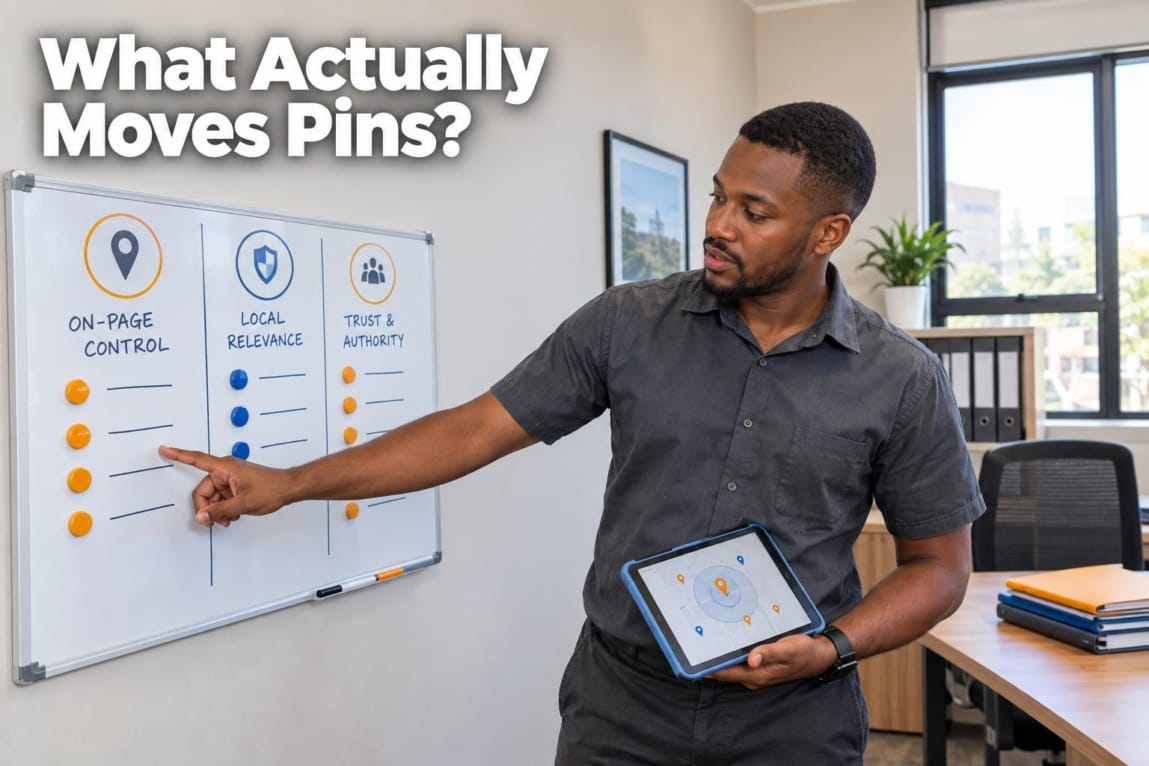
Appearing in Google Maps is not accidental, and paying for an advert does not automatically move a business into the organic local 3-pack. When someone in Gaborone searches for an auto service, or a customer in Francistown searches for a consulting firm, Google tries to show businesses that best match the need, make sense for the searcher’s location, and appear established and trustworthy.
The most useful way to understand Google Map ranking factors is to separate them into three groups: factors you control directly, factors you can influence over time, and factors you cannot change. That distinction helps Botswana businesses stop chasing shortcuts and focus on the work that can improve local visibility.
The Short Answer: How Google Decides Local Rankings
Google Maps rankings are mainly based on relevance, distance, and prominence. Relevance is how well your Google Business Profile and website match the search. Distance is how close your business is to the searcher or the location named in the search. Prominence is how well-known and trusted the business appears online and offline; Google’s own guidance refers to this dimension as popularity.
Google explains these three pillars in its local ranking guidance. It does not publish a complete list of signals or fixed weights, so no one can honestly promise a specific Maps position.
A verified profile can still rank poorly for a service query, and a business that is missing entirely may have a different issue involving eligibility, verification, suspension, or setup. Use this guide on why your business may not be showing on Google Maps if the listing cannot be found at all.
The Local Ranking Control Matrix: What You Can and Cannot Change
Local SEO works better when effort follows control. You can correct an inaccurate category this afternoon; you cannot relocate a searcher standing near a competitor. Put the basics under your control in order first, then build the outside signals that strengthen prominence.

| Local ranking factor | Level of control | Primary pillar | Practical action |
|---|---|---|---|
| Primary and additional categories | Direct control | Relevance | Choose the most precise category for your core service, then add only genuinely relevant supporting categories. |
| Profile completeness and accuracy | Direct control | Relevance | Complete hours, phone, services, website, address or service area, and accurate map location. |
| Website relevance | Direct control | Relevance | Build clear local service pages with matching business details and a usable mobile experience. |
| Review frequency, quality, and responses | Partly controllable | Prominence | Ask real customers consistently for honest feedback and respond professionally. |
| Inbound local links and mentions | Partly controllable | Prominence | Earn recognition from relevant local organisations, partners, events, and publications. |
| Directory citations | Partly controllable | Relevance and prominence | Claim or correct legitimate listings so your name, address, and phone details agree. |
| Searcher physical proximity | Out of your control | Distance | Compete strongly in your real operating area rather than trying to simulate another location. |
| Searcher location and search history | Out of your control | Distance and personalisation | Check performance from several areas and do not judge visibility from one search alone. |
Think of the matrix as a priority tool, not a secret formula. Google can use many signals and the importance of a signal can vary by search, location, competition, and business type.
Fully Controllable Factors: Optimizing Your Primary Foundation
Direct control means there is little value in leaving avoidable gaps. Before seeking links or sophisticated campaigns, make sure Google and customers can understand exactly what you do, where you operate, and how to contact you.
Primary Category and Additional Categories
Your primary category is a strong statement about your main business activity. A workshop should choose the category that most accurately describes its core offering, rather than a broad label chosen only because it sounds popular. A consultancy should not select unrelated categories simply to appear for more searches.
Additional categories can add useful context when they reflect real services. They do not replace a focused primary category, and adding irrelevant options can make a profile less clear. Select the fewest categories needed to describe the business accurately, then keep service descriptions and website content consistent with that choice.
Data Completeness and Verification Integrity
Complete operating information reduces friction for both Google and prospective customers. Check your business name, phone number, hours, website, services, products where relevant, and customer-contact method. Keep the business name as it is used in the real world, not as a place to insert extra services or locations.
Accurate location details matter especially where plot numbers, wards, landmarks, or unnamed roads make an address difficult to interpret. Confirm that the map pin marks the actual customer-facing location or operational base. A correct pin helps customers navigate to you; it is not a proven way to expand a ranking radius.
If customers visit your premises, show the genuine physical address. If you travel to customers and do not serve them at your address, configure the business as a service-area business instead. For local help with these choices, see how to set up and verify a Google Business Profile in Botswana. Verification supports a legitimate, usable listing, but does not guarantee a top Maps ranking.
Website Relevance and Local Landing Pages
The website linked from your profile gives Google more context about your business. A strong local page names the service, explains who it is for, provides genuine location context, and makes it easy to call, send a WhatsApp enquiry, or submit a form.

Match your business name, address, and phone details across the website and profile. If you serve Gaborone and Francistown from genuine operating locations, describe each location accurately rather than publishing thin city pages for places where you have no presence. Mobile usability and fast page delivery also matter because many local searches happen on a phone when a customer wants to act quickly.
For a structured self-check of categories, services, address details, and website alignment, use this Google Business Profile optimisation framework.
Partly Controllable Factors: Building Digital Prominence
Prominence is not fully under a business owner’s control because customers, websites, and communities decide what they say and link to. It can still be influenced through reliable service, ethical follow-up, and a consistent local presence.
Customer Reviews, Ratings, and Owner Responses
Reviews give potential customers evidence that others have used and valued the business. Google also says that more reviews and positive ratings can help a business stand out. Build a repeatable habit: after completing a job, sale, consultation, or appointment, invite the customer to leave an honest review.

A steady request process is more credible and sustainable than a sudden, artificial-looking campaign. Do not offer incentives for positive reviews or tell customers what to write. Natural mentions of services or locations can provide useful context, but they should come from the customer’s genuine experience.
Verified owners can request reviews using a link or QR code and reply publicly to feedback. Google’s guidance for managing customer reviews explains these tools. Reply calmly to both praise and criticism, without exposing customer information or arguing in public.
Local Citations and Directory Consistency
A citation is a mention of your business details on a directory, industry listing, business registry, partner site, or local portal. The practical priority is consistency: use the same real business name, phone number, address format, and website wherever the business is listed.
For Botswana businesses, small differences can matter operationally. One listing may say a plot number, another may use a nearby landmark, and a third may show an old mobile number. Record your preferred public format, then correct important listings gradually. Citations are supporting evidence, not a substitute for a useful profile, credible reviews, or a relevant website.
Inbound Links and Local Mentions
Links and mentions from relevant local sources can strengthen the wider evidence that your business is established. Useful examples include a chamber listing, a genuine supplier or partner page, a local event sponsor page, industry association coverage, or a regional publication mentioning your work.
Focus on being legitimately useful and visible in the local business community. Buying low-quality links or creating pages purely for links can create risk without building real trust.
The Uncontrollable Reality: Why Distance Rules Google Maps
Distance is the local ranking factor that causes the most confusion because excellent optimisation cannot erase geography. For a “near me” search, Google normally gives strong consideration to where the searcher is at that moment. A well-optimised business in Gaborone West may not outrank an equally relevant competitor close to a customer in Phakalane.
Results can also change across a city. In areas with many similar businesses, the local results may become more tightly clustered around the searcher. In areas with fewer options, Google may show businesses from further away. An explicit search such as “accountant in Francistown” gives Google a named location to consider, but relevance, prominence, and the searcher’s context still matter.
This is why a single search from your office is not a complete ranking report. Check the results from different parts of the service area, use searches that reflect real customer language, and separate organic Maps visibility from paid map adverts.
4 Dangerous Local SEO Myths That Waste Business Time
1. Adding keywords to the official business name
Changing “Kgetsi Motors” to “Kgetsi Motors Best Car Service Gaborone” may look tempting, but it misrepresents the business name if those words are not part of the real-world name. Google’s guidelines for representing your business require names to reflect the business’s real-world branding. Non-compliant information can lead to edits, removal, or other policy consequences.
2. Relying on geo-tagged photo metadata
Some advice claims that adding GPS data to photo files will improve Maps rankings. Google does not publish this as a local ranking factor. Upload useful, genuine photos because they help customers assess your premises, work, products, and team—not because hidden metadata is expected to create a ranking lift.
3. Creating a virtual office or fake address
A virtual office, borrowed address, or unstaffed location does not create a legitimate local presence. Use a real customer-facing location only when it meets Google’s representation requirements. If you travel to clients, use a legitimate service-area setup rather than inventing an address in Maun, Francistown, or another town to manipulate proximity.
4. Assuming Google Ads raise organic Maps rankings
Google Ads can place paid local advertising in front of relevant searchers, but advertising spend does not directly buy a better organic Maps position. Treat paid search and Google Maps SEO as connected visibility channels with different mechanics and measurement.
Action Plan: How to Systematically Improve Your Local Map Visibility
- Audit categories. Confirm that the primary category describes the core service customers should find first. Remove categories that do not represent real offerings.
- Complete and verify profile data. Check contact details, hours, services, customer-contact options, address or service area, and map-pin accuracy.
- Align your website. Ensure the linked page clearly explains your services and location, matches your business details, and works well on mobile devices.
- Create an ethical review habit. Ask genuine customers for honest feedback at a sensible point after service, and respond to reviews consistently.
- Correct important local citations. Start with reputable directories, industry listings, partners, and regional platforms where customers may find you.
Google map ranking factors reward clarity, legitimacy, usefulness, and local trust—not tricks. Start with the signals you control, build prominence patiently, and set expectations around the geographical limits of your actual location.
If several issues overlap—such as profile setup, local landing pages, citation consistency, reviews, and technical website SEO—Lephutshi Developers can help you diagnose priorities and implement a practical plan. Explore Local SEO and Google visibility support for a tailored local visibility review.
Recommended Reading
- Why Is My Business Not Showing on Google Maps? 12 Things to Check
- How to Optimize Your Google Business Profile for Local SEO: The Complete Framework
- How to Set Up and Verify a Google Business Profile in Botswana
FAQ
- How do I rank higher on Google Maps?
Improve the factors you control: use the most precise primary category, complete your Google Business Profile accurately, verify the correct location or service area, collect genuine reviews, and link to a fast, relevant website with matching business details. Your position will still depend on distance, competition, and the searcher’s context. - How do I get my Google Business Profile on top of the 3-pack?
No single tactic can guarantee a top-3 Maps position because proximity is decisive. Maximise your chances within your real operating area by pairing accurate categorisation and complete profile information with genuine reviews, local recognition, and a relevant website. - How long does Google Maps optimisation take to work?
Direct profile edits, such as changes to categories or hours, may be reflected within days, though Google may review changes. Prominence improvements from reviews, citations, links, and website alignment usually need consistent work over weeks or months and are not guaranteed to change rankings. - Does changing my business address require Google Business Profile verification again?
Moving a verified business to a new address requires verification again under Google’s current profile editing guidance. A business name change may also require verification, while minor edits do not necessarily trigger the same process. - Can I rank in Google Maps for a city where I do not have a physical address?
You should not create a false or virtual address in that city. A legitimate service-area business can define areas it serves, but adding a city does not create a physical location or guarantee Maps visibility there; a real customer-facing location must be represented accurately.